Alberta Innovates — Summer Research Studentship (SRS)
The Alberta Innovates Summer Research Studentship (SRS) provides experiential learning opportunities for undergraduate students interested in emerging health-related technologies, research and innovation (R&I) during the summer months (May - August).
The objectives of the SRS program are to:
- Increase awareness and interest in research & innovation (R&I) careers - particularly at the intersection of health and emerging technologies.
- Create opportunities for emerging talent to acquire experience and connections in Alberta’s health R&I ecosystem.
- Increase the competitiveness of Alberta as a destination for R&I talent.
- Leverage partner relationships to advance priority area activity in Alberta.
Previous Projects and Awardees
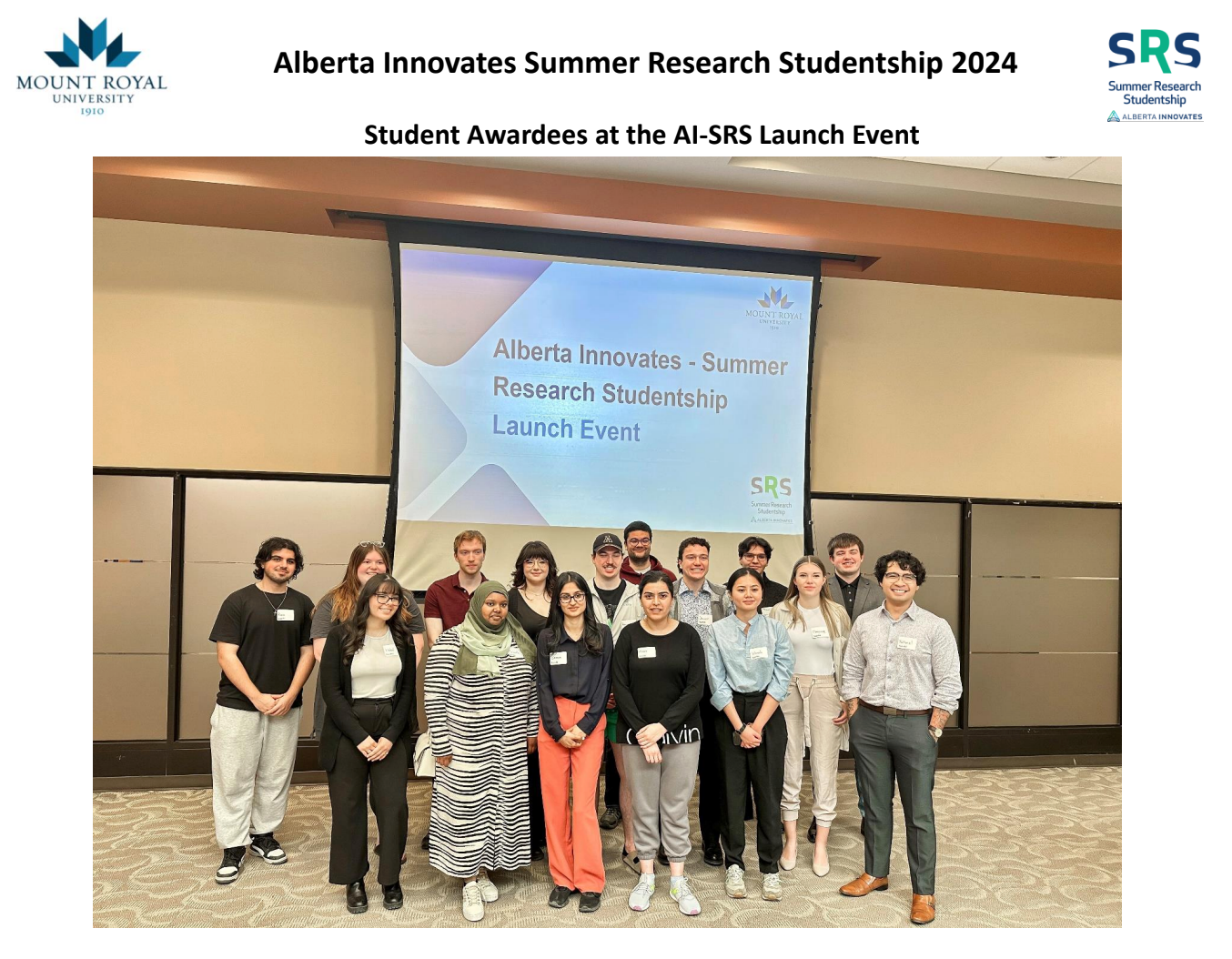
Project Titles and Awardees 2024
Camryn Moline and Benjamin MacKenzieJessica
- A high resolution characterization of the incidence and severity of central sleep apnea (CSA) and the role of blood acid-base balance with rapid ascent and residence at 3500m
Emily Kingdon and Rami Mikha
- Comparative genomic analysis of perilipins across eukaryotic diversity
Dawson Sheehan
- Developing an app to predict older adults' abuse in an Emergency Department
Nathaniel Penas and Cheyenne Hammell
- Development of a computerized decision support system for a provincial shoulder clinical care pathway (MAP SHOULDER)
Aidan Andrews and Malaadh Baadel
- Development of an application for feblile disease diagnosis by frontline health workers in resource-limited settings
Simreen Dhaliwal
- Exploring the impact of mobile health (mHealth) applications on patient adherence to medication regimens in chronic disease management
Hibba Zia and Caden Albright
- Improving the translation of drug discoveries into clinical therapeutics - Exploring the effect of complex solution environment on the function
Santina Duarte and Thomas Kapocsi
- Simulating psychedelic-induced neuroplasticity in an artificial-intelligence model of major depressive disorder
Khanh Le and Bryce Carson
- spatialEpisim: an R Shiny app for tracking the spread of infectious diseases
Isabel Melendez and Zakari Mulrooney
- Unresolved trauma and post-traumatic stress disorder in older adults
Project Titles and Awardees 2025
Jessica Sadler and Alyssa Peppler
- Perceptions of Social Media Self-Diagnosis: Challenges and Impacts in Mental Health Practice
Jose Guillermo Gomez Castro
- Building an Artificial Intelligence Model of Post Traumatic Stress Disorder
Jaskaran Maan
- Improve urban water environment with permeable pavement under Calgary's winter climate conditions
Darren law Yan Lun
- Bridging Statistics and Digital Health: Machine Learning Innovation in CougarStats
Muskaan Kainth and Hareem Tariq
- Using comparative genomics to clarify the evolutionary relationships between the lipid droplet protein seipin in mammalian and yeast genomes
Santina Duarte
- The effects of oral glucose ingestion on cerebrovascular regulation in healthy males and females
Emma Gardener
- The synergistic effects of passive heating and hyperventilation on blood acid-base regulation in healthy males and females
Toka Hassan and Malaadh Baadel
- Leveraging ML to Transform Febrile Disease Diagnosis in Resource-Limited and Vulnerable African Countries
Allen Magpusao
- Data-Driven Discovery of New Antimicrobials
Alaina Sawatsky
- Improve Physical Activity: Phase II
Jace Kinoshita
- The cardiovascular health impacts of exercise in wildfire smoke
Lina Yu
- Understanding joint work contributions to economical locomotion across the lifespan
Dawson Sheehan
- Developing an app to detect elder abuse in an Emergency Department (ED).
Kelsi Dickson
- Beyond MAP SHOULDER - Integration of Active Rehabilitation Modules
Maren Walker
- Canadian Caregiver Experiences of Caring for Children with Medical Complexit; Informing a Community of Practice in Childhood Disability
Sadra Shamanian
- Utilizing Age-Tech and Med-Tech to Develop a Comprehensive Geriatric Assessment (CGA) Toolkit for Health Care Providers
Katelyn Bennett and Zakari Mulrooney
- Multi-Modal Motion-Assisted Memory Desensitization and Reconsolidation (3MDR) for Medical Trauma in an Older Adult
Demola Yusuf and Josenari Diakanamwa
- Transforming Early Childhood Health: A Data-Driven eHealth Intervention for Educator Capacity Building
Alberta Innovates priority areas for 2026
As a condition of our funding from Alberta Innovates, 80% of awards are to be directed to projects that align with one or more of these priority areas Digital or Data Driven Health Research, Commercialization, and Health System Transformation. Please see the definitions below. The remaining 20% of awards may be used towards any other health or clinical research and innovation project.
Applied Health Research for Adoption & Scale
Projects that accelerate the development, validation, and deployment of health technologies and therapeutics with commercial or clinical potential. This includes prototype testing, regulatory planning, biomanufacturing, clinical trials, and usability studies. Students could contribute to real-world innovation pathways by working alongside academic, industry, community, or health system partners to bring solutions closer to market or care settings.
Sustainable Health Systems
Projects that design, implement, or evaluate innovative care models, service approaches, or policies that improve performance and sustainability in Alberta. This includes projects that are in collaboration with health service delivery partners, technology solution providers, or other health system entities.
Digital Health & Data-Driven Systems
Projects that advance the secure, ethical, and effective use of digital tools and health data to support care delivery, decision-making, and system coordination. Students could participate in applied research on digital platforms, AI/ML model evaluation, data interoperability, and virtual care integration, helping to shape the future of technology-enabled health services.
One Health
Projects that address the interconnection of human, animal, and environmental health to prevent, detect, and respond to shared threats through cross-disciplinary, collaborative, applied activities.
Application process
- Supervisors will submit an Expression of Interest outlining a summer student project by 11:59 p.m. MST, Feb. 24th, 2026. Supervisors are to use this google form.
Each supervisor may receive a maximum of 16 total funded student weeks per application cycle. These 16 weeks can be allocated in the following ways: Two students for 8 weeks each (total = 16 weeks), or One student for 8 weeks, or One student for 12 weeks, or One student for 16 weeks
Supervisors may structure their applications in either of these ways:
- Request up to two students on a single project, or
- Submit two separate projects, each requesting one student
- However, the combined total across all projects must not exceed 16 funded weeks per supervisor per cycle.
- Accepted supervisor projects will be posted on the website for students to apply to by Mar. 17th, 2026. List of Projects and Supervisors
- Students may apply for UP TO TWO summer student projects using this google form (Available Mar 17th, 2026). Student Applications are due by 11:59 p.m. MST, Mar. 31st, 2026.
Applications may be downloaded here, but MUST be submitted via google form to be considered.
Deadlines
Supervisor expression of interest deadline
11:59 p.m. MST, February 24th, 2026
Student application deadline
11:59 p.m. MST, March 31st, 2026
Value and term
Studentships will be available for periods of 16 weeks, 12 weeks, or 8 weeks between May and August.
16-week awards are in the amount of $7,500;
12-week awards in the amount of $5,625; and
8-week awards in the amount of $3,750.
Payment will occur on a bi-weekly basis. Alberta Innovates does not provide additional funds for health-care benefits. The payment of such benefits is the responsibility of the awardee.
Student eligibility
To be eligible to hold a SRS Studentship, studentship applicants must:
- Be registered in an undergraduate degree program at Mount Royal University
- Students in their last semester may apply, as long as they are enrolled as an undergraduate at the time of application, and are not entering a graduate program during the term of the award.
- Students must be in good academic standing prior to the start of the project (see Calendar — Academic Standing). Students will be asked to submit their transcripts along with their application.
- Students may not hold another stipend-type award concurrently (i.e. NSERC USRA and similar awards). Supervisors may choose to supplement (“top-up”) the Alberta Innovates Summer Research Studentship, provided this does not conflict with the policies of the secondary granting agency, and that the student does not receive the full value of the second award.
- Students must be available to work a minimum of 8 consecutive weeks (2 months) between May and August. Given the diversity of Summer Studentship projects and project timelines, the Centre does not prescribe specific hours of work for students. Students are expected to commit a minimum of 25 hours a week to the research project during the award period. In no case should Alberta Innovates SRS students commit more than an average of 35 hours per week.
- Considering the limited duration of Summer Studentship projects (2-4 months), it is generally expected that students will not have other conflicting commitments (i.e. summer courses, exams, volunteer, work). Therefore, in advance of undertaking a project, students are encouraged to discuss with their supervisors any commitments that may influence their availability, and come to a mutual agreement with their supervisors about hours of work during the project.
Review process
Each faculty application will be reviewed by the administration committee, consisting of MRU faculty and the project coordinator, for relevancy and criteria outlined within the Supervisor Expression of Interest Application form. Each application will be scored based on this rubric.
Student applications will be reviewed by each project's supervisor. Supervisors may optionally conduct interviews. Based on these reviews, all of the Alberta Innovates Summer Research Studentship proposals are ranked and assessed to determine the award recipients. Decisions are final and cannot be appealed.
Adjudication decisions are not appealable. Applicants who are unsuccessful are welcome to reapply in a future application cycle, and are encouraged to contact the Centre for Health and Innovation for feedback regarding their application.
Competition results are normally available in April. All applicants will be notified (via email) of their status by mid April. If you have not been notified of your application outcome by April 17th, 2026, please contact our office.
Conditions of award offers
Award recipients are expected to follow the procedures and rules of the research environment in which they conduct their research and interact regularly with their supervisor.
Award recipients are to provide a report at the end of their award period, and ensure it meets the expectations of the Alberta Innovates Summer Research Studentship program.
Award recipients are strongly encouraged to complete post-studentship surveys from Alberta Innovates. Alberta Innovates may survey award recipients for up to five years following the studentship completion to measure the impact and benefits of the studentships.
To make the most out of the AI SRS experience, it is strongly recommended that award recipients do not take more than one course during the Spring/Summer terms. Students wishing to take more than one course must first discuss the matter with their supervisor and obtain approval.
If the award recipient is not meeting the conditions of the award as outlined in this form and the supervisor's expectations, the administration committee will conduct a review to determine continued student eligibility. Payment may be withheld for the remainder of the term if the student is not meeting outlined expectations from the supervisor or found to no longer be eligible for the award.
If for any reason the project is discontinued, the student will receive partial funds prorated to the date of discontinuation.
Award recipients offered an Alberta Innovates Summer Research Studentship will be required to accept or decline the offer by a date specified in the notification of the offer.
Award recipients who decline the award may claim credit for the award on their curriculum vitae, noting that the award was declined. In the event successful students decline the initial offer of award, no further offers will be made for this competition.
Alberta Innovates Summer Research Studentship recipients may not simultaneously hold any similar award, including but not limited to the NSERC Undergraduate Student Research Awards or other similar awards.
Conduct of research
Research funded by an Alberta Innovates Summer Research Studentship must comply with all Mount Royal University guidelines concerning the conduct of research.
Alberta Innovates Summer Research recipients are to conduct their research in a safe and ethical manner under the guidance and mentorship of their supervisors. They are expected to follow the procedures and rules of the research environment in which they conduct their research and interact regularly with their supervisor.
All research that involves the use of human subjects must be reviewed and certified as acceptable by the Human Research Ethics Board (HREB), any research involving animals must be certified by the appropriate Animal Care Committee (ACC), and any biomedical studies must be certified by the University of Calgary’s health board (CHREB). The responsibility for adherence to these guidelines is jointly shared by the supervisor and award recipient.
The research project should not be substantially altered from that proposed in the original application. If significant changes should become necessary, the trainee must obtain prior written approval from the Centre of Health and Innovation in Aging to continue with the award. The supervisor must agree with the proposed changes and the original aims and conditions of the award must be satisfied. The Centre may request written confirmation from the supervisor to confirm his or her agreement with the proposed changes.
Communications
All publications, including public messages, arising from research supported by Alberta Innovates grants or awards must acknowledge the support. Visit the Alberta Innovates Visual Identity Guide for more information.
Award recipients are asked to inform the Centre for Health and Innovation in Aging in advance if their research will be published in a major journal such that it might result in a press release from the university and/or the journal. This information will be provided to Alberta Innovates communications staff.
Alberta Innovates reserves the right to publish and/or disseminate information regarding its grants and awards.
Final Report and Presentation
Students and supervisors are required to submit a final report to the Centre for Health and Innovation in Aging upon completion of the award. Students will also be asked to present their work at the closing event in August/September 2026. Failure to provide the final report by the posted deadline may result in disqualification from future Alberta Innovates Summer Research Studentship competitions. Additional information will be provided to successful applicants.
*adapted from Alberta Innovates, University of Alberta, University of Calgary, and AI-SRS Program Information
SPARK Alberta
SPARK Alberta is a one-year program for academics developing digital health innovations, acting as a first stepping stone into the innovation ecosystem. SPARK works with teams from any Alberta post-secondary institution, offering access to our group of industry advisors, curated learning opportunities, and ecosystem connections to resources, programs, and funding to help you on your journey.
Applications for the Fall 2025 cohort are now closed. Spring 2026 applications will open in February 2026.
For any questions, please reach out to spark@ucalgary.ca