
Announcing our Changemaker in Residence - Courtney Walcott
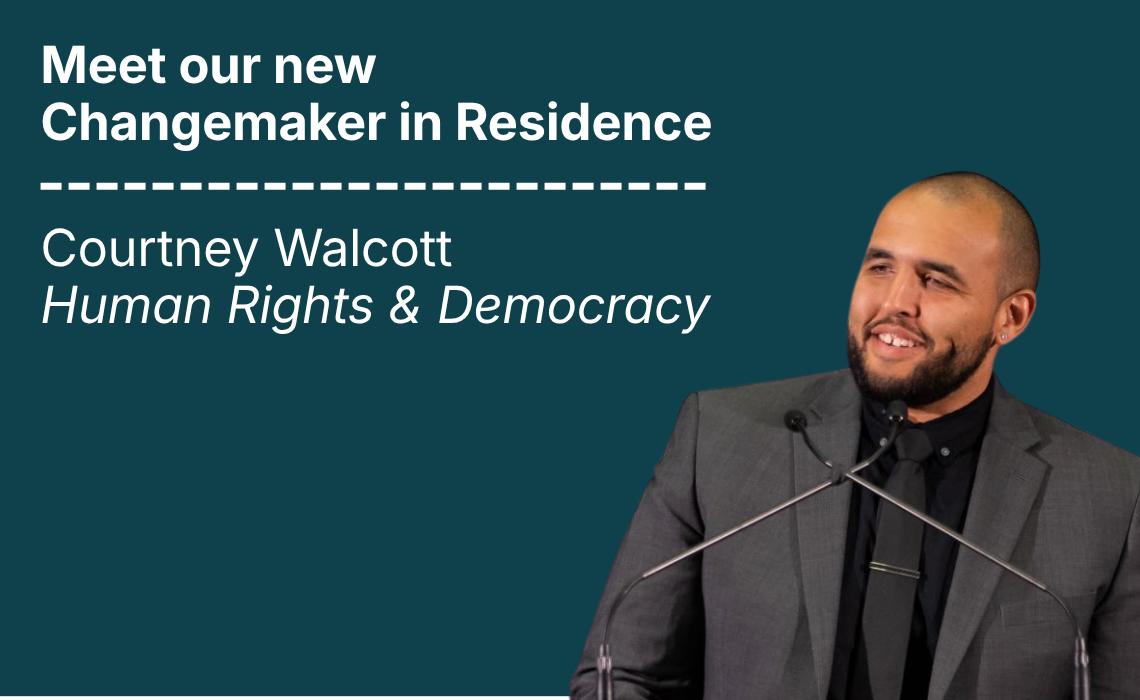
Human Rights & Democracy is a two-year Changemaker-in-Residence initiative led through Mount Royal University’s Institute for Community Prosperity in partnership with Dignity Forum. The project responds to the need for deeper public education, dialogue, advocacy, and systems-level understanding of human rights in Alberta and Canada. It positions human rights as a foundation of community prosperity and creates a structured platform for campus-community learning, civic engagement, and action.
The project is centered on an animating question: Can human rights be guaranteed under a democracy?
Core activities include public lectures, community and campus workshops, guest lectures, Lunch & Learns, student programming, publications, special projects, and facilitated conversations on the relationship between human rights, democracy, systems change, and civic responsibility.
A Q&A with Courtney Walcott
What does it mean for you to be a Changemaker in Residence?
Sometimes speaking up about things that matter to you and your community can feel like screaming in a crowded room. To be heard nowadays, it often requires someone to extend an opportunity to lift the voices of others above the noise. I view the Changemaker in Residence as an opportunity to lift the voices of those around me that have ideas that can change the world.
What big, beautiful question drives your work?
“Who hurt you?” I’m not joking. I have spent my life and career at points of tension that shape the lives of those around us. At these points of tension, whether in the public school system or in politics, I have seen people drive forward choices that advance their own self interest at great cost to numerous people. But rather than write them off, I have had a lot of opportunities to dig into the motivations behind these choices and more often than not, the prevailing feeling underneath the harm is a sense of fear and loss. People are afraid that change will be painful, that they will lose something, something that so few can articulate.
I ask “who hurt you” so I can be reminded to sit in the pain they may be feeling, before challenging them to decide if they want to continue these painful cycles that inevitably damage others. “Who hurt you” is the entry point to the tension between feelings of self-preservation and self-sacrifice.
“Who hurt you?” is how I think about breaking the cycle. Ask the question, understand the pain, and then get on the same team and do some good together.
Can you describe your changemaking journey?
I joke often that I love community… just when it is “over there.” I didn’t grow up with a specific community around me. I didn’t grow up knowing where I belonged. But what I did know is that there were these systems that saved my life all around me. I grew up in subsidized affordable housing. My family was no stranger to food banks, church food vouchers, holiday hampers, and familiar text of an eviction notice ripped up in the garbage because we got the payment in under the wire.
My mother was a single mom who worked with vulnerable women, many of whom were leaving human trafficking. She was injured on the job where someone improperly loaded an elevator, and when the doors opened on my mom, a couch spilled out and almost broke her back. My sisters and I became intimately aware of the in’s and out’s of emergency room visits as her health deteriorated in the following years. I grew up, not in one system, but across many systems.
I grew up knowing that these systems have the potential to help families like mine, across communities, to keep families whole and to give opportunities where otherwise they would be lost. So even though I didn’t have a large community, I found myself dedicated to improving the systems that helped all communities.
I am a teacher because I believe education is a foundational system for change. I am a community organizer because I believe social movements can shape systems and institutions. I became a politician because I know our elected leaders have the power to lead communities through change. And I am the changemaker in residence because I believe it is a position that can inspire others to become changemakers in their own right.
Why is it important to you to focus on human rights for this project?
It can feel as if people view human rights as concrete, stable, and a guaranteed part of our society. But they’re not. The concept of a human right is often viewed as a guaranteed aspect that is inherent to all of us simply by being human. This can lead to a level of complacency with the systems that protect human rights, and when the complacent aren’t looking, there are those who seek to restrict, remove, or create divisions that disqualify human rights from applying to all people.
This is not just conjecture, but a reality that many systems from public education to the judicial system are facing a concerted effort to change the social contract first through a growing counter culture movement followed by legislative pullbacks of human rights protections once assumed secure.
It is important that people who believe in human rights remain vigilante, and that even in moments of security, we ensure that the human rights remain an embedded and active part of our culture.
What are you most excited for during this process?
This process is about building up shared values of human rights. I am most excited about the opportunity to elevate this discussion, and to elevate leaders that will carry this work forward after me.