
An UPEND Shift In Alberta: How Nonprofits, Governments, and Charities Work Together Differently
The Problem With Business As Usual
The traditional government-nonprofit relationship relies on an antiquated funding model: Nonprofits compete for limited government grants, and the funding body is rarely the financial beneficiary of the intervention. This feedback loop—which fails to reward success or signal failure—allows systemic and wicked problems like unemployment and homelessness to worsen.
UPEND is a practitioner’s guide for civil servants, nonprofits, and charities that aims to provide tools and learnings to support modernizing the relationship between government and the social sector through social and outcomes procurement. This publication is written by Shaun Loney with contributions from the Institute for Community Prosperity’s Barb Rallison.
“The systems-change UPEND will bring to life will show that competition is good! Instead of nonprofits competing with each other, let’s use tools that promote competition between the nonprofit sector and areas where government is getting very bad outcomes.” - Shaun Loney, Upend resource p.g.16
Something had to change. And in Calgary, it did.
A Different Kind of Deal - StartWork Applies UPEND Tools
In Alberta, many skilled refugees rely on Alberta Income Support to support their transition into the labour market. Not due to a lack of desire to work, but because the system failed to connect newcomers to jobs quickly. This resulted in a rising caseload for the Ministry of Assisted Living and Social Services and a window of opportunity for the Ministry to do things differently.
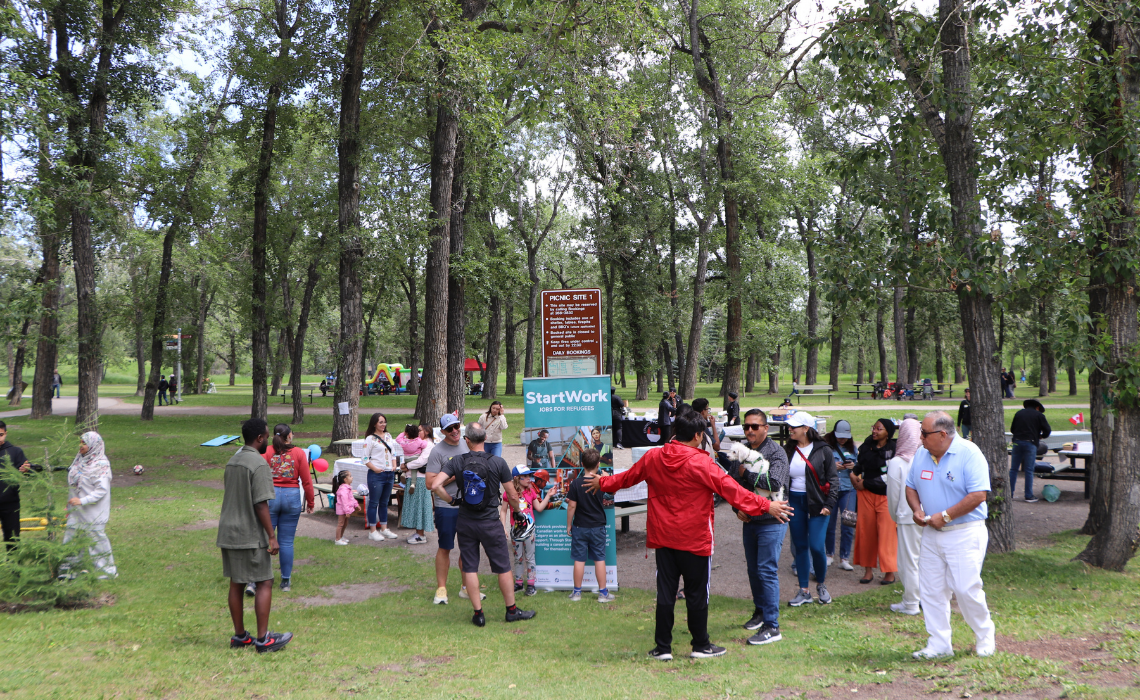
StartWork is a novel partnership that is applying the tools of UPEND to upend the traditional relationship between nonprofits and government by invoicing the government only after outcomes are delivered. The partnership between the Ministry, Northpine Foundation, and the Institute for Community Prosperity at Mount Royal University (MRU) was established in 2024 in order to deliver training and employment outcomes for 40 refugees on Alberta Income Support. Together with collaboration from nonprofits and social enterprises, they piloted what the UPEND practitioners guide calls outcomes procurement—a model where the government pays after a measurable result is delivered, rather than funding activities upfront with no guarantee of impact.
The terms were straightforward. The Ministry agreed to compensate MRU for every refugee who moved off Alberta Income Support and remained off for 12 and then 24 months—at a rate that cost the Ministry less than it would have paid in continued Income Support. MRU, supported by a catalytic $1.2 million upfront investment from Northpine Foundation, took on the responsibility of delivering the result.
No outcome, no payment and the government is a customer, not just a funder. As UPEND frames it, the nonprofit sector has long been subsidizing government by delivering outcomes that reduce government costs, without ever being paid for that value. StartWork changes that equation.
From Pilot to Systems Change
The initial $1.196 million ministry contract proved the StartWork model, which offers comprehensive supports—like employment assistance, driver's training, and mentorship—to help 40 refugees find and keep jobs. MRU partnered with Centre for Newcomers, FireX3, Momentum, and WINS for delivery.
The next goal was scaling the model. A dramatically expanded $13.2 million contract was negotiated in late 2025, starting November 1, 2025, to move 300 Alberta Income Support recipients off support over three years, generating significant cost savings. Momentum is facilitating StartWork’s second outcomes based procurement contract with the Ministry, leading trades-based training for StartWork participants while working closely with social enterprises, local businesses, and non-profits to support job placements. MRU’s role is to promote social procurement and grow Calgary's social enterprise job capacity, while supporting coordination. Crucially, the second contract required no additional philanthropic investment; the initial $1.2 million from Northpine Foundation was a one-time catalyst that unlocked ongoing government procurement revenue, demonstrating the model's self-sustaining design.
Building the Ecosystem
StartWork is also helping to build the infrastructure that will make this kind of work sustainable and replicable.
As part of the expanded initiative, MRU is providing mentorship and resources to Calgary Dream Centre and Calgary John Howard Society to launch two new trades-based social enterprises in Calgary. These will offer employment pathways for StartWork participants and others facing labour market barriers.
MRU is also assessing work-integrated social enterprises in Calgary, examining their revenue and hiring models. The resulting report, submitted to the Government of Alberta, will recommend ways to support this sector as a lever for employment, especially for those historically excluded.
Additionally, the StartWork team continues advocacy, engaging all levels of government to promote broader adoption of modern procurement approaches between governments and nonprofits.
A Model Worth Spreading
Three parties made StartWork possible, each playing a role that the model requires. The Government of Alberta created the market by agreeing to pay for an outcome it genuinely wanted. MRU and its community partners offered the expertise and the delivery infrastructure. And Northpine Foundation provided the upfront catalytic capital that made it possible for the nonprofit sector to take on the risk of delivering first and invoicing later.
None of these three parties could have done it alone. All three had to be willing to do something different.
That's the insight at the core of UPEND: the tools to make progress on poverty, unemployment, and inequality already exist. What's needed is the willingness to use them differently—to have government act as a customer, foundations deploy their endowments as well as their grants, and nonprofits step forward as vendors of outcomes rather than applicants for funding.
StartWork is proof that this shift is possible.
And in Calgary, it's already underway.