A Thriving Social Service
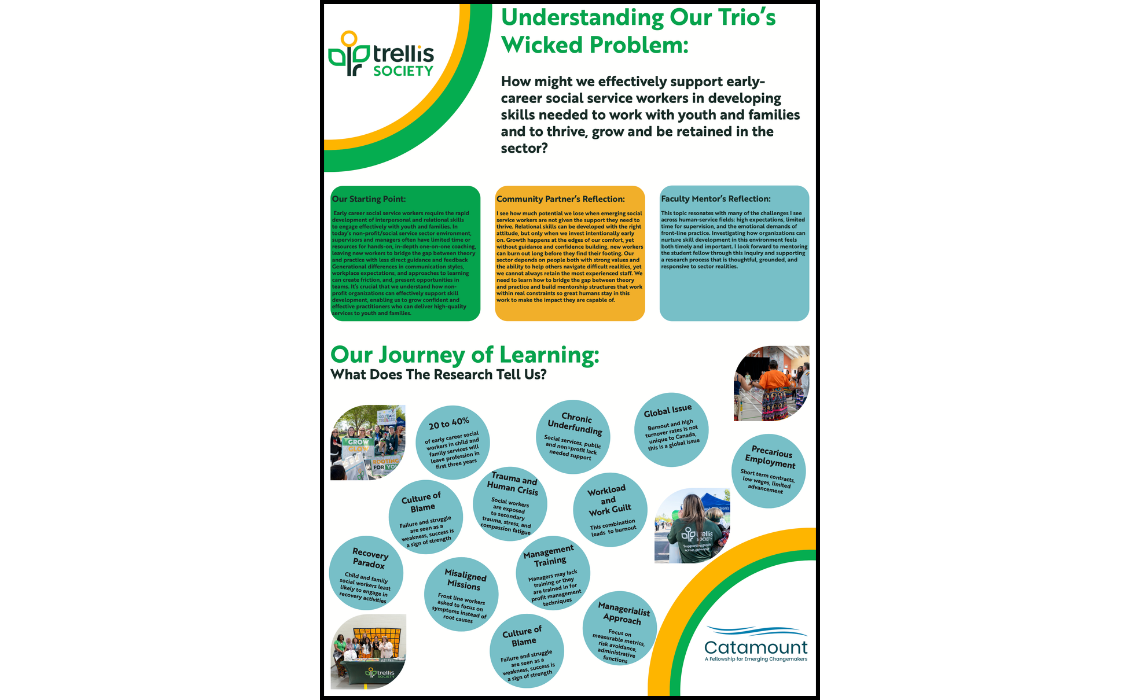
How might we effectively support early-career social service workers in developing skills needed to work with youth and families and to thrive, grow and be retained in the sector?



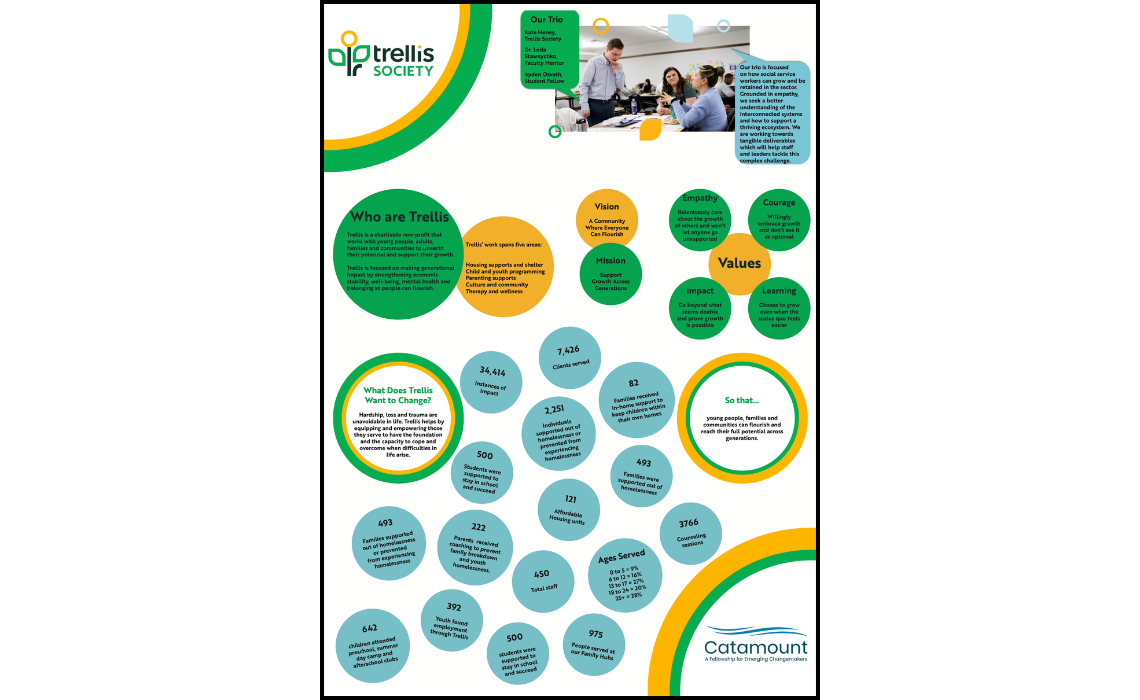
The Thriving Social Service trio focused on how social service workers can grow and be retained in the sector. Grounded in empathy, they sought a better understanding of the interconnected systems and how to support a thriving ecosystem. Ayden, Kate, and Leda worked towards tangible deliverables which help staff and leaders tackle this complex challenge.
Process of Learning
To start their learning journey, the Trio gained an understanding of what the academic research has discovered in relation to early career social workers, with a focus on social workers practicing in the field of child and family services. A literature review of peer reviewed academic sources was completed and the relevance and key findings from the academic literature was summarized in a Research Dossier prepared for the Trio. The Research Dossier also identified what the research considered to be key factors in the ‘problem landscape’ and the ‘solutions landscape’.
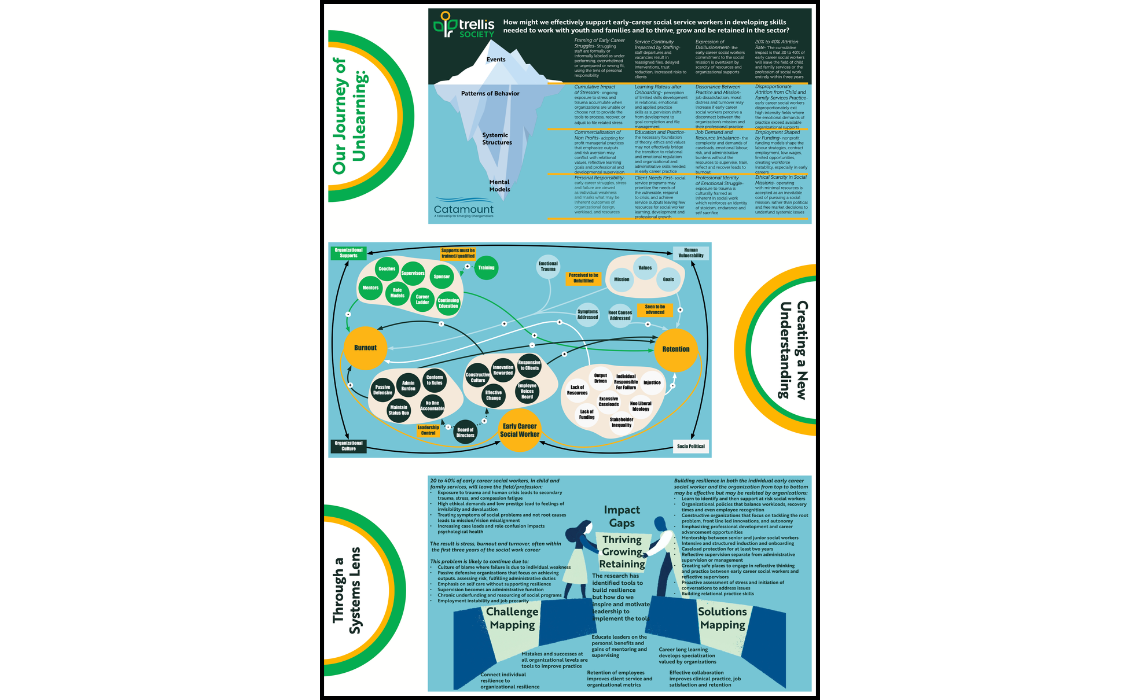
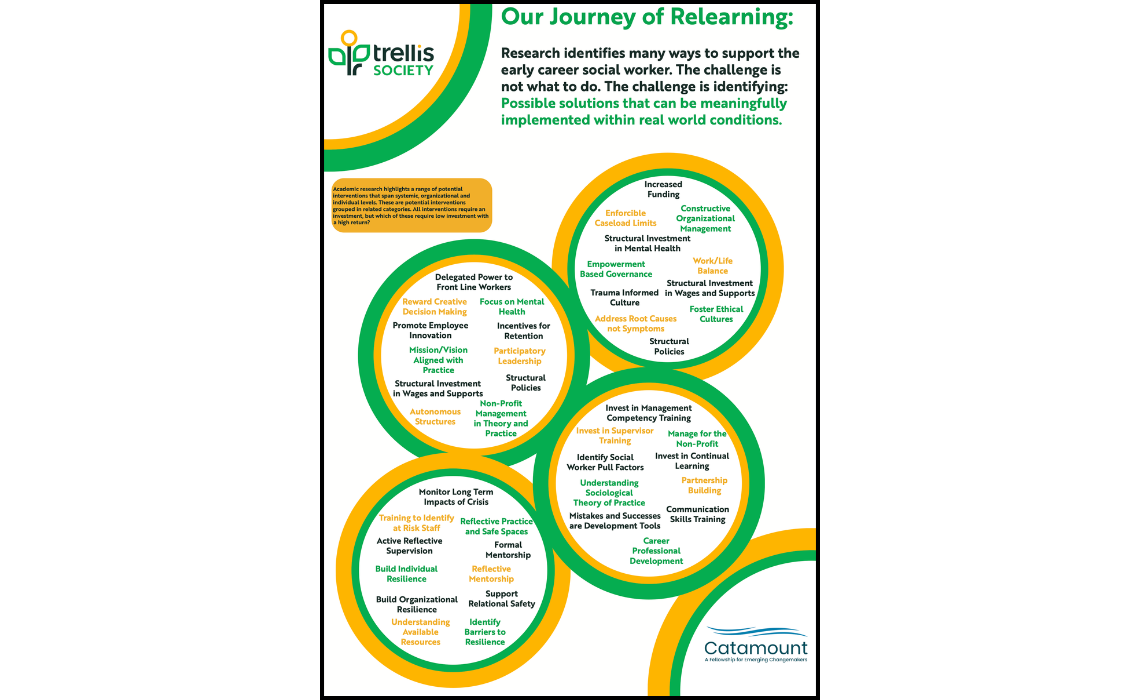
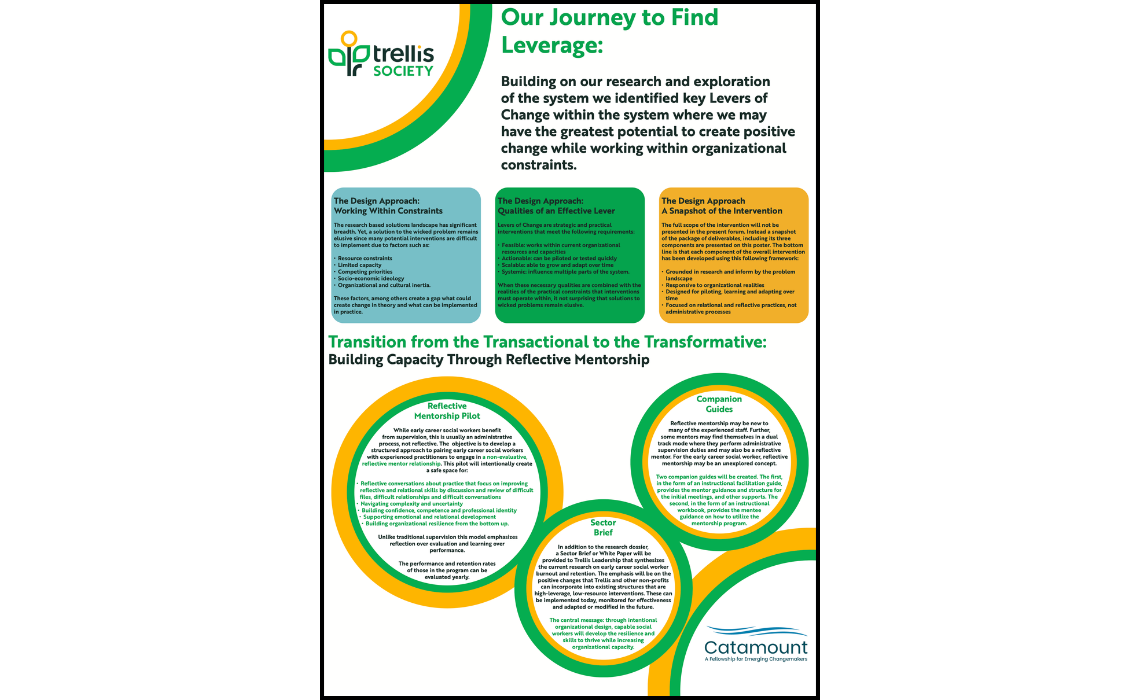
The Trio then analyzed the findings from the research through three systems thinking tools to help make visible the underlying systemic and structural dynamics leading to high burnout rates and low retention rates of early career social workers in the practice of child and family services. These tools included a Systems Map, Iceberg Model, and Impacts Gap Canvas. Each tool examined the findings of the academic literature from a different perspective, which when viewed together helped create a visual understanding of a small portion of the system within which social service organizations and early career social workers currently function. The academic research, these three visualizations, and the collaborative discussions between the Trio provided guidance on meaningful and actionable deliverables that could be developed for Trellis and other peer service organizations. To help make sense of the learning journey to that point, a series of five posters were created that provides an overall visual representation and summary of the Trio’s learning journey to that point.
Use directional arrows to move between posters or click the images to open each pdf.
The Deliverables
As The goal of the Trio was to avoid creating another academic paper that analyzed the systemic problem of early career social worker burnout and turnover rates. Instead, the focus of the Trio was to identify and then design a meaningful and actionable intervention that Trellis could implement within its existing organizational realities and constraints. In other words, the intervention had to be a potential lever of change within the control of Trellis leadership that did not rely on changing existing soico-political realities and funding constraints. The proposed intervention did, however, have to be adaptable, scalable, and have measurable outcomes.
The proposed intervention is the implementation of a structured Reflective Practice Mentorship Pilot Program which relies on the internal human resources of Trellis, requires minimal monetary investments, and is strongly supported by academic research. The two key elements in the design of the proposed intervention was the strict separation of the role of the administrative, managerial, and evaluative supervisor of the early career social worker and the reflective practice mentor assigned to the early career social worker. This distinct separation allows for the two supervisory functions to exist in parallel while ensuring that the early career social worker can build and develop their capacity and resilience in a safe and confidential space. The second design element is that the early career social workers capacity and resilience is addressed individually and takes into account each social worker's individual struggles and learnings as they begin their professional practice. This individualized approach also allows the reflective practice mentor to better monitor their mentee’s growth, development and mental health and well-being.
The final deliverables prepared for Trellis include: a Sector Brief for senior leadership; the Reflective Practice Mentorship Pilot Program; a Companion Guide for the Reflective Practice Mentor; a Companion Guide for the Mentee; and, a Reflective Practice Toolkit for the Mentee.
Sector Brief for Senior Leadership
Reflective Practice Mentorship Pilot Program
Companion Guide for the Reflective Practice Mentor
Companion Guide for the Mentee
Reflective Practice Toolkit for the Mentee
Sector Brief for Senior Leadership [pdf]
Reflective Practice Mentorship Pilot Program [pdf]
Companion Guide for the Reflective Practice Mentor [pdf]
Companion Guide for the Mentee [pdf]
Reflective Practice Toolkit for the Mentee [pdf]
Reflection on my Learning Journey
The Catamount Fellowship took place over the course of my final semester in Information Design and Social Innovation. In so many ways this Fellowship was a culmination of my learning as I had an opportunity to put to the test my research, systems thinking, and human centered design skills as I tackled my wicked problem with my learning trio. Working hand in hand with my trio, and particularly my community partner, was an eye opener as I had to focus not on ideals or the ideal solution, instead I had to gain empathy and understanding of organizational realities and constraints. A single project, a single learning trio, a single service organization cannot change an entire system on its own, and certainly not with any speed. What I did learn was that using all the research, being creative, and being fully mindful of existing constraints, does not prevent the design of meaningful interventions. The intervention may not be perfect, but it can certainly be good enough and, as my community partner most aptly phrased it, we were able to design an intervention that can help transition social service organizations from the transactional to the transformative by building the capacity and resilience of not just the early career social worker but also the organization as a whole. When the reflective practice mentorship pilot program is introduced, I hope that I will have the opportunity to follow up and see the results over the following year, two years, and three years. As a final thought, for any student who wants to push themselves, who want to see change not only within systems but within themselves, then I encourage them to explore the opportunity to become a Catamount Fellow.