 MENU
MENU



Truth, media and misinformation
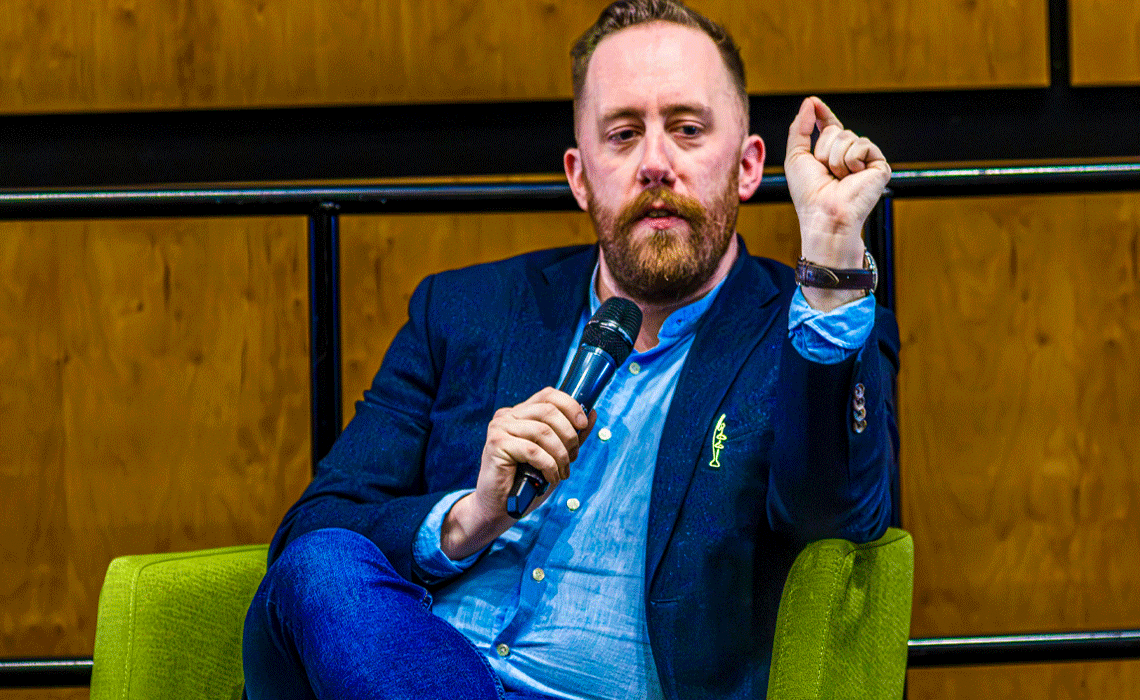
As part of the Faculty of Business, Communication Studies and Aviation’s Journalism Spotlight Lecture series, on March 11, Mount Royal University hosted award-winning journalist Justin Ling for a talk titled, “Telling the truth in hyperreality: Journalism in a time of lies.”
An investigative journalist and Toronto Star columnist, Ling’s lecture in Ross Glen Hall spoke about the “bad actors” of online spaces: those who deliberately spread misinformation. He said members of society have a responsibility to be vigilant and skeptical truth-seekers.
Dr. Brad Clark, PhD, a professor of broadcast media studies and journalism and digital media at MRU says it’s important to spotlight journalism as a crucial component of a democratic society in a time where many are led to believe it’s not relevant.
“It’s so fundamental to our conventions that ensure the viability of democracies. We need to have discussions like this,” Clark says.
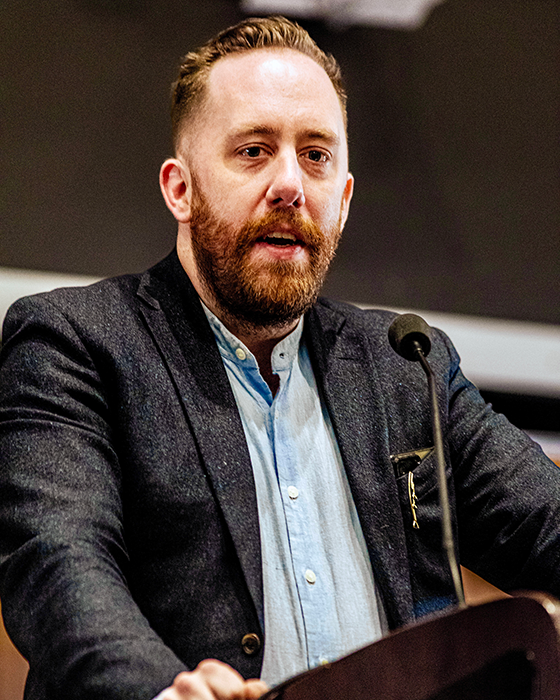
Organized into three parts, Ling began his lecture by quoting Russian-American scholar and essayist Mikhail Epstein, referencing hyperreality as “Disneyland” or “where reality itself is designed as a land of imagination.”
Part one focused on asserting how “fairytale can become fact” if consumers mindlessly gobble up what’s fed by the hands of oligarchs, bad actors and big tech.
Ling warned of everyone’s ability to unknowingly share, receive, believe and repeat lies.
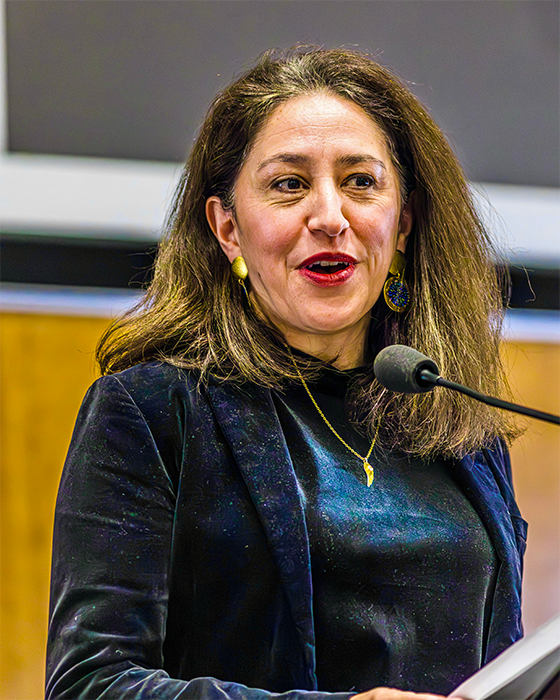
Dr. Gabriela Perdomo Páez, PhD, an assistant professor of journalism at MRU and the event’s moderator says, “We must not passively allow information to wash over us … without being critical.”
Ling says our ability to “hypernormalize” is a product of our active and passive consumption of lies, allowing falsehoods to persist and thrive.
“What we’re seeing today is a massive decentralized global effort to craft new realities,” he says.
“Unless we’re prepared to provoke and undergo a pretty radical societal shift, we risk sinking further into a state of delusion.”
Trust, truth and technology
During part two of the lecture, Ling focused his attention on addressing questions such as: What role does trust play in our acceptance and assertion of truth? And why do people believe things they know aren’t true?
Ling asked audience members to consider the following while highlighting the predisposition to “upload our lives to the internet.”
In the wake of big tech organizations such as Facebook, Ling turned back time to the 1940s. Then, a large group of academics across countless fields gathered to understand “what an explosion of technology would mean for humanity.”
They considered the potential for technology to radically transform society. Half the attendees at the time believed technology would “only make us more capable of being human,” while others foresaw future technology with skepticism, recognizing computers’ need for information and, therefore, power.
Technology, Ling asserted, is not neutral. Neither is the ability to engage in online spaces
He argued that although most of society’s thinking is in line with those who believed computers would be a mind upgrade, it must instead align with those who questioned the system.
The difficulty lies in the inability to resist what exists on screens.
“Your thoughts, photos, beliefs, were suddenly accessible to all, and vice versa. Suddenly we found ourselves performing and being performed to.”
Enter the algorithm
Facebook is just one of several media machines that use algorithmic mechanisms to determine what is seen on screens, tinkering with variables and recommending content “all in service of keeping you on the platform longer.”
Through a 2022 study, Ling pointed out how researchers found a shift in news reporting after media platforms introduced voting with emotions.
“Neutral headlines declined rapidly. Sad headlines started performing better, started to evoke more fear in our readers … and we really started making them angry,” Ling says. “Emotion doesn’t just make us more likely to engage, it makes us more likely to believe nonsense.”
He went on to explain how the propensity to believe this "nonsense" and “fall into absurdity” became even more tedious with the rise of artificial intelligence.
According to Ling, the expansion and rapid growth of AI is one that promotes “powerful, delusional thinking in quite normal people,” even with “the shortest exposures to relatively simple programs.”
'The organization is the future adversary'
In his third and final section of the lecture, Ling concluded by acknowledging the decision to “centralize truth” on the internet and suggested a solution.
“If we want a single solution to our crisis of information, it’s simple. Shut off the world wide web, shut down the social internet.”
Although he agrees this isn’t a “practical policy solution,” he does offer other more tangible courses of action, such as returning to “strong, hard-nosed journalism”
For Ling, this means the goal should be to simply inform.
We must “give people the stuff they don’t want. Tell people the things they don’t want to hear. That’s journalism.”
Pursue books over online summaries, engage in in-person forums, lectures and conversations in hallways, lunchrooms and bars, and decentralize spaces.
“The truth is we’re playing a rigged game. There is no amount of engagement that we can do on a platform that will help the truth win. Because the truth is not supposed to.”
During the question-and-answer period, audience member Kelly Hofer asked, “Centralized platforms have become the architecture of hyperreality itself. Is there a path where individuals and communities can build their own decentralized tools for communication?”
In simple terms, Ling replied “Yes.” However getting the public to know, understand and consistently use new platforms or formats is often a challenge.
Reddit is one space that Ling says isn't a bad answer.
“It’s a system that allows anyone to set up their own community and allows them to self-moderate. It allows people to set standards and it generally does not exploit the conversation for benefit.”
In Hofer’s experience, in-person meetings and variety in news sources have been useful tools in pursuing decentralized spaces.
“The message of the social media companies is put out by the company themselves,” he says. “And the message isn’t so much one that our friends or people that we follow want to tell us. So I’m open to new ones.”
Hofer says the lecture was a great opportunity to serve his curiosity and do exactly what Ling encourages us all to do: download lives from the gamut of online spaces.
MRU aims to continue highlighting lectures and in-person public forums like this in the future.
Watch the full lecture recording below.