 MENU
MENU



Celebrating the night sky
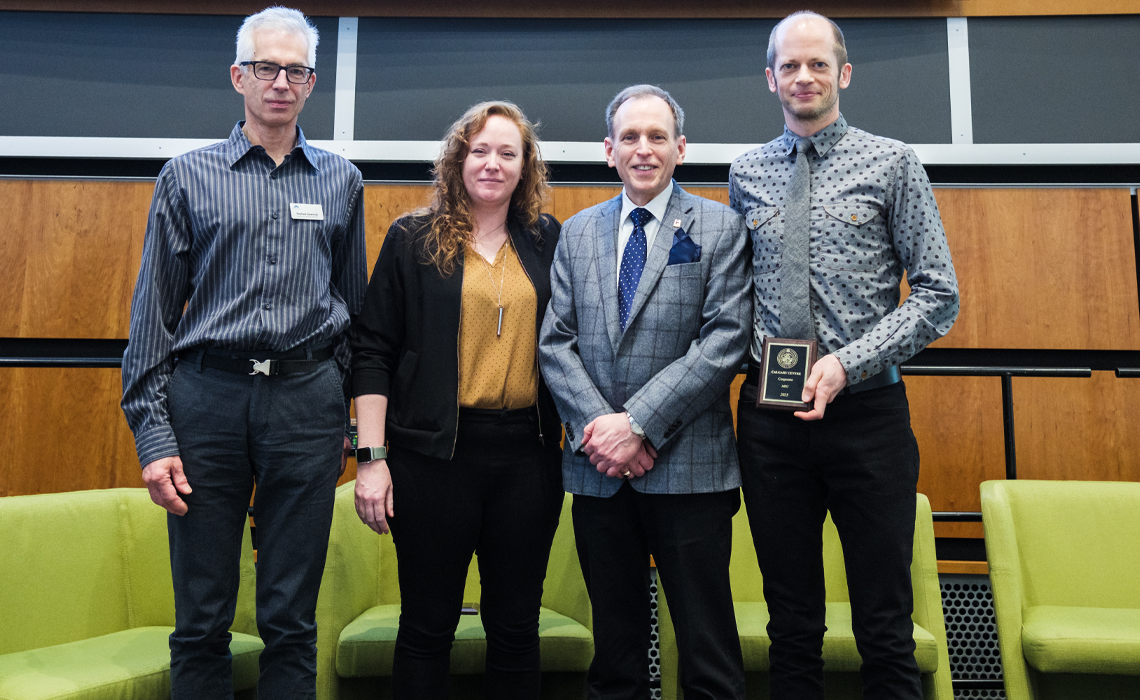
Mount Royal had the opportunity to celebrate the stars on March 30, as the University was the proud recipient of two awards from the Royal Astronomical Society of Canada (RASC) — Calgary Centre.
Since 1868, the RASC has been inspiring interest and knowledge of astronomy and related sciences, explains Robyn Foret, who is a two-time past-president of the RASC — Calgary Centre, 26-year volunteer and a past-president of its national chapter. He is also a Fellow of the Royal Astronomical Society of Canada.
The RASC spans 30 cities across Canada and has more than 4,000 members consisting of professional and amateur astronomers with a specific interest in outreach activity, “which provides direct value to the public and indirect value to the scientific community,” Foret says.
The awards were given out at a Research and Scholarship Days event, with the first being the 2025 Corporate Award in recognition of MRU’s hosting of regular Star Parties. Along with Foret, also on hand for the presentations were Heather Laird, RASC president, Calgary Centre, Dr. Jonathan Withey, DPhil, dean of the Faculty of Science and Technology and Dr. Raphael Slawinski, PhD, associate professor and chair of the Department of Physics and Chemistry.
“Mount Royal University was an ideal candidate for our award this year,” Foret says. “Calgarians typically fill our outreach events, so having new events such as Star Parties at an urban academic campus ticks so many boxes for us both. It provides new opportunities for public engagement, it opens the door to astronomy to new audiences and it introduces the Mount Royal campus in a family-friendly and fun way to potential students and supporters,” Foret says.
Those Star Parties are the work of Dr. Stephen Jeans, PhD, of MRU’s Department of Physics and Chemistry, Department of Earth and Environmental Sciences and the Bissett School of Business. Jeans, who is also a member of the RASC, has organized a number of Star Parties with the help of the RASC, whose planetary enthusiasts have supplied the well-attended evening events with telescopes and expertise.
In addition to the support of the RASC, several of Jeans’ students have also taken part as volunteers, setting up pylons and safety tape, greeting guests, teaching about star-chart reading and assisting those of all ages in finding objects in the night sky. Also joining in have been faculty members from physics, chemistry and across all the disciplines, operating telescopes and answering questions about science from the public.
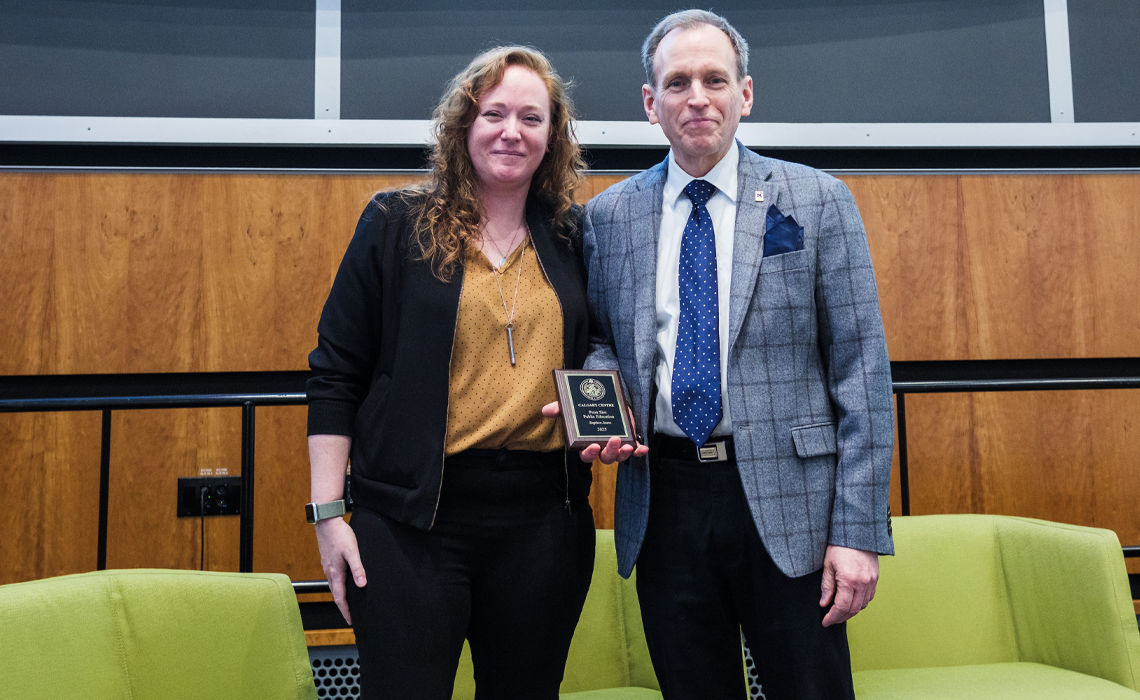
Jeans received the second of the RASC awards, the 2025 Peter Sim Public Education Award. Sim was a former RASC member who is described by Foret as “the heart of volunteer astronomy education in Calgary.
"Peter had a rare gift; not just knowledge of astronomy, but a passion for teaching people how to think scientifically," Foret says. "During his volunteer years, Peter reached more than 13,000 students and he led his efforts with this simple but profound philosophy: 'It’s not the knowledge — it’s the importance of knowing.' "
That description exemplifies Jeans, whose regular media appearances caused weather specialist Jody Hughes of CTVNews to exclaim, “I want to be in your class!”
“Astronomy is an accessible science available to almost everyone from their backyard. Children, especially, get excited when they see celestial objects for the first time and their enthusiasm often translates to their family and friends and even to their own academic journey,” Foret says, adding that MRU student involvement helps undergrads build confidence in their skills.
“As a servant to our community, MRU builds trust in what we teach and opens doors to higher learning that might not otherwise be open to everyone in our busy world,” Jeans says. “I thank the dedicated amateur astronomers of the Royal Astronomical Society of Canada — Calgary Centre who have worked countless hours with only the gratitude of the many smiling faces we put before them.”
Jeans’ first Star Party saw a turnout of 300 people and was notable for the ability to see a very bright Jupiter. The last event saw more than 1,000 people in attendance and 20 telescopes in operation, with plenty of curious children looking for things like planets, red stars and clouds in space.
“There are many reasons to share science for advancement of knowledge, to dispel misconceptions and inform our next generation and to raise awareness of the dangers and beauty of our existence,” Jeans says.
“We are delighted to see Dr. Stephen Jeans recognized with this award and we are honoured to be the recipient of the 2025 Corporate Award from the Royal Astronomical Society of Canada — Calgary Centre. Together, these awards reflect the kind of work we want to be known for in Science and Technology: excellent science education, meaningful community engagement and hands-on opportunities. While Jeans’ leadership has been central, this recognition also speaks to the many employees, students and community partners who make these events possible,” Withey says.
The wonders of the universe
Astronomy can be described as a “gateway” science, or even “informal” science, as both Foret and Jeans agree. It’s one that introduces the disciplines of physics, chemistry, meteorology, biology, mathematics and more. Astronomy has influenced human behaviour throughout the existence of humans on the planet, with the day-to-night cycles being the most obvious and perhaps most consequential effect of planetary movement. Ancient cultures used the planets to navigate and calculate, including determining the size of the Earth and its distance to the sun. What might be the most wondrous part of the discipline is that stars and planets belong to no-one, yet everyone at the same time.
“Knowledge of astronomy is important for everybody,” Jeans says. “If you know how to read the sky, then you also know about finding your way around direction-wise. When looking up at the night sky, knowing what's going on with celestial phenomena helps to make the science and sustainability of our planet much less of a mystery. It puts your universe in perspective.”
Jeans was a student in high school when he first became involved with the RASC, and he credits that connection with leading him down the path to academia. In addition to astronomy, he also teaches environmental science and geography.
“I want the students to experience astronomy for themselves, and enjoy it, and then have a sense of the awe of nature, the power of nature, and the massiveness of nature when they look out into the darkness of space. Then we can postulate really weird questions like how did the universe begin and the big bang. Jupiter and Saturn and Pluto and all the rest of them have oxygen, helium, nitrogen, potassium and chemicals and the carbon that we're made out of. It’s all the natural building-blocks of our world and other worlds.”
The future of space observation and exploration
In addition to astronomy leading to a better understanding of life on Earth, it may help solve some of the planet’s most pressing issues. Jeans firmly believes that in the very near future resources will be mined from space.
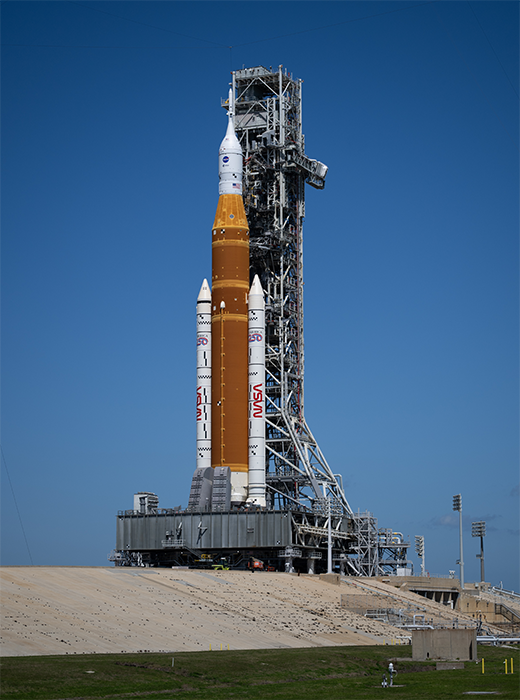
“Look at NASA. They're sending the Artemis II mission up in the next month. And the whole idea is to put people in space and on the moon, harvest the moon and bring it back to Earth. And then they're going to use the moon as a gateway to Mars,” Jeans says. “We're learning how to survive on the moon so that we can send people to Mars, where people will actually live all year round.”
People will be inhabiting the moon in year-round housing starting in 2028, Jeans proposes, and that it’s likely humans will reach Mars in the 2030s. That makes science more important than ever — in every field — in order to fully understand the implications of space developments, including the more than 10,000 satellites launched and currently in orbit.
“So, now here are the questions we have to ask. How much stuff and what should the rules be about putting things into outer space by countries, artificial satellites above our heads that might fall on us, that might contaminate our atmosphere, that might block our way of going to the moon. And this becomes geopolitics as well,” Jeans says.
“Taking a little bit of science with the disciplines that you're interested in is now becoming the norm.”
Jeans explains that the moon is basically covered in a dust called regolith, a type of non-soil material that, if mined, will likely yield hydrogen-3. That can be used as a fuel to take humans to Mars, making the moon a kind of gas station pit-stop for the eight-month journey.
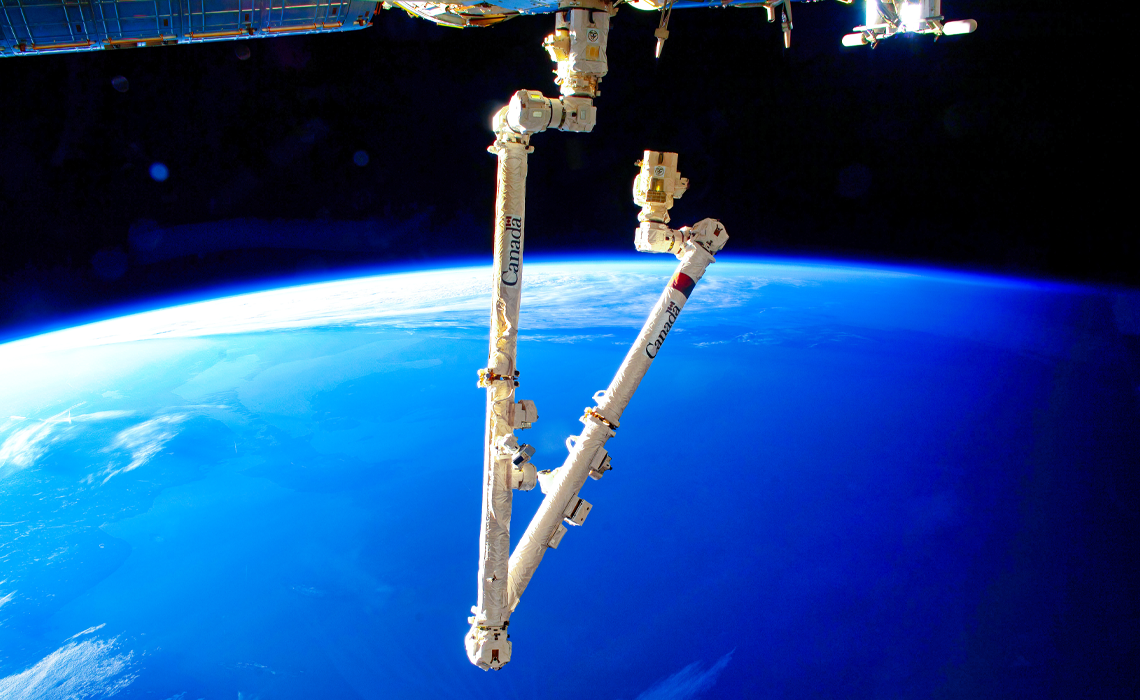
“Some of the students at MRU, I promise you, will be living on other worlds or working on the supports and technologies like Canadarm for those who will. Canada is working on several rovers for the new space station as well. And so we will literally have people involved in the industries of building rockets, landing people on other planets, looking for near-Earth objects that may impact Earth, figuring out how to keep people healthy and radiation-free in space, scientists to look at the extraction of water and minerals, designers and engineers to make the systems for survival, those growing food, setting up data systems and communications, and a whole lot of other critical fields.”
A new observatory is on the way
To help accommodate the growing interest in space and Star Parties, in partnership with the University of Calgary and Calgary Parks and Recreation the RASC Calgary Centre is setting up a new public observing location that will accommodate more people than the current Rothney Astrophysical Observatory. Programming is likely to begin in 2027 and the new observatory will be located in Ralph Klein Park in southeast Calgary as part of the City of Calgary’s Environmental Education Centre.
“Most people are familiar with environmental issues that are important to all of us, but that familiarity often lags when it comes to the nocturnal environment. In addition to educating the public about the night sky and what they are seeing, it’s an opportunity to inform the public of the importance of the nocturnal world, too, and the importance of protecting that,” Foret says.
The new facility will offer opportunity to people of all ages to engage in astronomy, as visitors, as students, as volunteers and advocates of science and the nocturnal world, he says. Jeans and the Faculty of Science and Technology are among the stakeholders who are interested in this new venture and discussing the possibilities for MRU’s involvement in the future of astronomy in Alberta.