 MENU
MENU



Co-creating the classroom

What happens when students are invited to help shape the way they learn? At Mount Royal, that question is moving from theory to practice through a new classroom-based pilot program.
Conversations about Teaching (CAT) pairs students with faculty to observe classes, ask questions and reflect on pedagogy in the classroom in real time. Led by Dr. Cherie Woolmer, PhD, assistant professor and Canada Research Chair (CRC) for the scholarship of teaching and learning (SoTL), the initiative builds on more than 15 years of research.
“My specific interest is what happens when we move from researching on students, treating them as research subjects, to partnering with them as co-creators, researching their learning with them and deciding what actions to take together,” Woolmer says.
At its core, this work challenges a traditional model of higher education. Instead of knowledge flowing only in one direction from faculty to student, it positions teaching and learning as a shared, relational process. It creates possibilities for co-ownership and shared responsibility in post-secondary education.
Where research meets the classroom
SoTL is a growing field of applied research focused on understanding and improving how teaching practices shape student learning. At Mount Royal, this work is anchored in the Mokakiiks Centre for the Scholarship of Teaching and Learning, a hub where faculty from across disciplines can study their practice and build a community around evidence-based research.
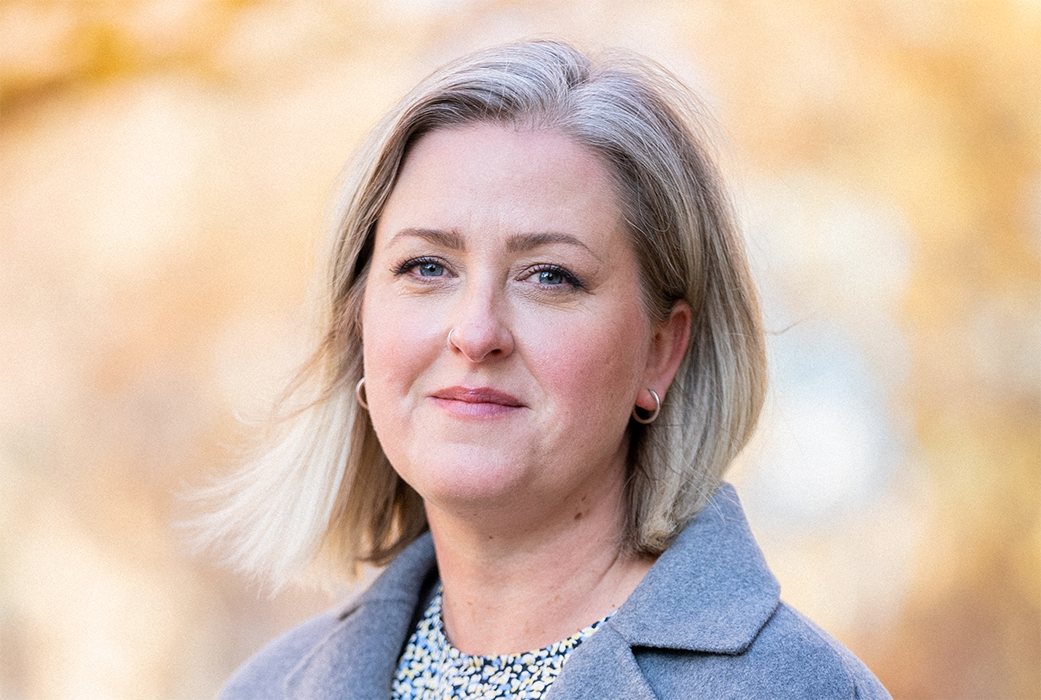
Woolmer’s work has focused on bringing students into this process as co-researchers within SoTL and is grounded in what she calls “disruptive ecosystems” — the idea that shifting power dynamics in the classroom, and in the field of SoTL, can influence broader institutional culture, particularly around equity and inclusion.
“It’s about making universities more just,” she says. “And that starts by working in partnership with the people most affected by teaching and learning.”
Unlike many CRC programs that focus primarily on external research, Woolmer’s work is deeply embedded at Mount Royal, while still contributing to international scholarship.
Dr. AnneMarie Dorland, PhD, associate professor of marketing and director of the Mokakiiks Centre, says that balance is what makes the work stand out.
“The CRC research that Cherie is doing is incredibly unique,” Dorland says. “She’s brought a new model of collaboration and creation to our SoTL community, while also connecting MRU faculty to an international network of scholars.” The Conversations about Teaching program is a concrete example of research being applied to practice, with immediate impact to MRU faculty and students.
Dorland adds that the project is a "groundbreaking" capacity-building program. "Mokakiiks is committed to rigorous and collaborative inquiry, and I can't think of a better example of this in action."
How Conversations about Teaching works
The CAT pilot, launched in January, pairs student partners with faculty members outside their areas of study, giving them a fresh perspective on how learning unfolds.
“It’s important that the student is bringing what it feels like to be a learner,” Woolmer says. “They aren't an expert in the content, but they are an expert in the experience of learning.”
Students are paid for their time and begin with a two-day training session focused on partnership, observation and inclusive teaching practices. Each week, they attend a class, take structured notes and meet with their faculty partner to debrief. Faculty and student partners meet on a monthly basis with Woolmer as part of an ongoing Community of Practice.
The program is intentionally non-evaluative. Rather than assessing performance, it creates space for ongoing dialogue, reflection and mutual learning.
“Students are seeing how much faculty worry about doing a good job. They see those micro-moments: ‘Did I handle that well? What’s your perspective on this?’ Conversely, faculty start seeing students as whole people, with a broad perspective on what it is like to be a learner at MRU,” Woolmer says.
“The whole point of working in partnership with students in this field is really about trying to make university spaces less hierarchical and more collegial,” she adds.
Seeing differently, together
Midway through the pilot, faculty are already using student observations to introduce new engagement strategies and adjust how they structure class time.
For some, the impact is measurable. Dr. Charles Hepler, PhD, associate professor in the Department of Mathematics and Computing, estimates that changes made through the partnership increased the average in his advanced theory class by five to 10 per cent.
“This is such a striking improvement that we’ve decided to work on my other two classes,” Hepler says.
Assistant professor of child studies Maureen Cullen notes the partnership provides access to aspects of learning that are usually hidden from faculty. “It’s not affirmational feedback,” she says. “It’s sustained attention to what pedagogy actually does.”
The shift is equally significant for students. “This position has provided a real appreciation for the work professors do,” says student partner Taylor Young.
Faireen Lalani, a senior student partner who also worked with Woolmer to design the program, adds that it has reshaped her understanding of education. “It’s about learning how to observe, notice patterns and sit with curiosity.” She describes the student partner role as “listening for what is not easily said,” such as noticing where energy shifts in a room or how instructions land in real time.
“It feels less like feedback and more like a shared inquiry into what learning looks like in practice.”
Building something that lasts
The CAT pilot marks the final phase of Woolmer’s CRC, with formal research on the initiative set to begin this spring. Lalani will continue to play a central role as a student research partner.
Looking ahead, Woolmer hopes to formalize a pathway for student involvement, connecting classroom observation, curriculum development and research into a single, collaborative pipeline.
“I think we have every potential to be doing something really exciting,” she says.
At Mount Royal, where smaller class sizes foster strong relationships, Woolmer believes the university is well positioned to lead. “It’s an antidote to seeing students as consumers,” she says. “We’ve all got a stake in how this works.”
In that shared space, learning becomes something built together.