 MENU
MENU



From archives to audio tracks

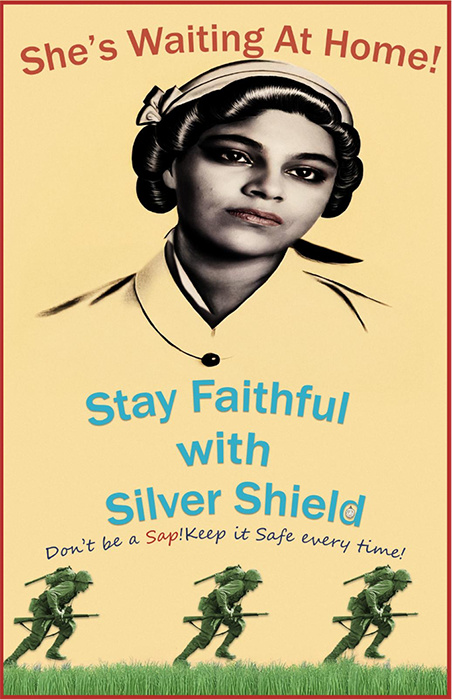
A jazzy jingle, a wartime-inspired poster and a 3D-printed product box – combining today’s technologies and the sensibilities of yesteryear, Mount Royal University sociology students Ilan Legotin and Arashdeep Mann’s history assignment for a history course turned into a full creative advertising campaign inspired by the 1940s history of contraceptive marketing.
Created for Topics in American History taught by Senior Lecturer Heather Nelson, PhD, the project creatively combined archival research, music production and design work in MRU’s Maker and Media Commons (Maker Studio). It is a general education course, which encourages students to explore subjects outside their primary field of study.
Legotin and Mann, both sociology majors, had recently taken the Sociology of Sexualities course, taught by Professor David Aveline, PhD, where they had learned about the history of contraceptives and how attitudes toward sexuality have changed over time. When they enrolled in Nelson’s history course on American consumer culture, they saw an opportunity to connect those ideas, embarking on an ambitious project that explored how advertising, gender roles and consumer culture intersected in the early decades of the 20th century.
“We wanted to do something unique that probably hadn’t been done in the class before,” Legotin says. “Most of the other projects were about things like cigarettes or cars.”
Instead, they proposed examining how condoms were marketed in the 1930s and 1940s, when discussions about sexuality were tightly controlled and advertising often relied on subtle messaging.
Nelson encouraged them to pursue the idea and suggested a creative twist that became the starting point for the project. “I asked them if they’d ever heard a 1940s advertising jingle,” she says.
This question proved to be the perfect prompt for Legotin, a self-taught professional musician who has composed tracks used by brands like Coca Cola and Sephora. He began researching music from the era to recreate the sound of a 1940s advertisement.
“I started listening to songs from the 1920s through the 1940s,” he says. “That period of big bands and swing music was really significant.”
Using digital music software, he composed and produced an original jingle inspired by those styles. Legotin and Mann then hired a vocalist through an online freelance platform to perform the track.
As they continued their research, Legotin and Mann expanded the assignment into a full advertising campaign. They designed a wartime-style poster, researched period slang and messaging and developed packaging for condoms that reflected the tone of 1940s advertising.
“We had to think about how people communicated at the time,” Mann explains. “You couldn’t be very direct when talking about sexuality. You had to sort of hint at things.”
The students even studied colour symbolism used in advertising. Blue, for example, was often associated with medicine and protection, so they incorporated it into the product design. One part of the campaign included a condom box label featuring a photo of Mann herself, styled in 1940s hair, makeup and attire. “I actually took the photo at Cactus Club,” she says with a laugh. “I told my friend to just take the picture and I’d explain later.”
The label was later paired with a 3D-printed box, produced in the Maker Studio at the Riddell Library and Learning Centre. Although the Maker Studio element was not originally planned for the course, Nelson says it emerged after the students began asking whether they could physically create parts of their campaign. Other students in the class soon began experimenting with the Maker Studio as well, producing physical artifacts inspired by their research.
“It became a way to engage with American history differently,” Nelson explains. “They’re still doing the research and understanding the ideas, but they’re expressing it in a completely different way.”
Students in the course visited the MRU Archives and Special Collections, where they examined historical documents and materials related to consumer culture. The experience allowed them to connect historical research with creative interpretation.
“Historians don’t just sit around reading textbooks,” Nelson says. “We go to the archives and work with the materials.”
This project marked Legotin’s first time working directly with archival material. “I had never been to the archives before,” he says. “Being able to see those materials helped us understand how things looked in the past.”
“It made us think about language, culture and advertising all at once,” Mann says.
Nelson says that interdisciplinary mix is one of the strengths of general education courses. Students from a wide range of programs often sit in the same classroom, bringing different perspectives to the discussion.
“We create the space,” Nelson says. “And the students take it from there.”
That freedom can lead to unexpected connections between disciplines, as Legotin and Mann experienced. They already have their next idea. They are now planning another historically inspired campaign, this time focusing on 1980s hairspray advertising, complete with retro music and visuals.
“We’re still in the planning stages,” Legotin says, “but we want to capture that ’80s energy.”
For both students, the project changed how they think about learning.
“You’re not just reading about history,” Mann says. “You’re building something from it.”