 MENU
MENU



Voted in

By day they are on campus working and learning, but when they leave Mount Royal their jobs are far from over. For one student, professor and staff member, evenings are spent shaping the future of their local Calgary-adjacent communities.
Lori Williams, a professor and political pundit with the Department of Economics, Justice and Policy Studies, says councillors play important roles in smaller urban centres and rural Alberta. She notes that the job is becoming more challenging as budgets become more limited.
“It’s important to recognize the commitment of some of these representatives, as well as the increasingly challenging environment in which they operate,” Williams says, noting that these part-time roles are rooted in public service.

Mikayla Gale, Bachelor of Business Administration student and and councillor for the Town of Cochrane
Born-and-raised in Cochrane, Mikayla Gale says that in a lot of ways, she has grown up with the town.
“Over the years, I’ve watched it change from a community of around 12,000 people to more than 40,000, and seeing that kind of growth first-hand really shapes how you understand change and its impact.”
Having served on both her local school council as well as Cochrane’s Youth Council, Gale had an early window into leadership and community involvement. Starting her own business at the age of 13 also played a huge role in her love for the town.
“That experience stayed with me and continues to shape how I view community and responsibility,” she says.
In 2025, Gale decided to get more involved and run for Cochrane’s Town Council. Between Gale, her mom and her sister, they knocked on doors and dropped flyers at more than 10,000 homes.
“I also built my website and designed all my signs and campaign materials myself,” she says.
“The whole process was definitely a learning curve, but the face-to-face interactions made the biggest difference. Talking directly with people about their concerns, ideas and hopes for the town was eye-opening.”
The Town of Cochrane is a bit different in that they run a general election instead of using a ward system. They have six council seats and Gale says she was pleasantly surprised to see she placed fourth out of eighteen candidates.
“The waiting was terrible, so I was a bit stressed. The ballots were counted by hand, and we didn’t get the results until almost 4 p.m. the next day. When I found out, I was thrilled, but also a little shocked.”
Since then, Gale has been hard at work attending conferences and jumping right into budget deliberations, all while balancing four classes.
“One helpful consideration is that council and Committee of the Whole meetings are held in the evenings, which keeps my days open for work or classes. Most meetings can be planned ahead of time, which helps with scheduling.”
Gale hopes to inspire other students to get involved in their communities. She says although the balancing act can be challenging, it has also instilled a newfound confidence in her.
“I learned pretty quickly that I didn’t need to have all the answers right away, but I did need to ask good questions and be willing to learn. It’s also shown me that there isn’t one “right” order to do things in life. You don’t always have to wait until you’ve checked every box to step forward, and that mindset has been really helpful in my role as a councillor.”
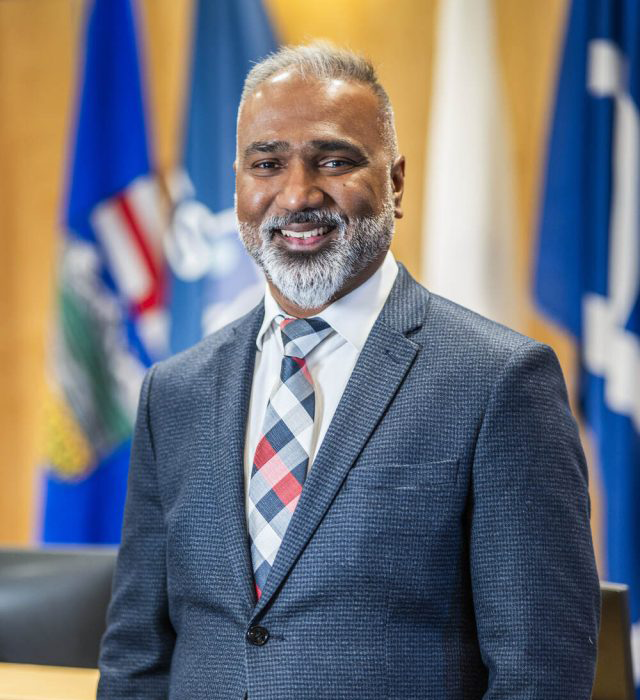
Dr. Ritesh Narayan, PhD, faculty member with the Department of Economics, Justice and Policy studies and deputy mayor of the city of Chestermere
Feeling like he had a lot to offer to his community, Dr. Ritesh Narayan, PhD, first ran for Chestermere City Council in 2017. Having previously only worked for private organizations, there was a steep learning curve when it came to understanding governance.
“It was like drinking water from a firehose to learn about how municipal government worked,” he says, adding that every member of council that was elected that year was also entering their first term.
Narayan was re-elected in 2021 and then again in the fall of 2025. Being in his third term, he’s the most seasoned member of council now.
“I do feel very confident, learned, and feel I have earned my feathers, “ he says. “My understanding of subject matters and governance is quite rich now. I feel I understand things faster and better. I don't have to ask as many questions as I used to, because I just get things.”
The path wasn’t always smooth sailing. Narayan says he had to make adjustments when he was first elected in 2017.
“It took me longer to get through council agenda packages, so I would convert files to audio and listen to them at the gym or when driving. However, over the years, I have developed a system and a healthy balance between teaching and being on council,” he says, adding that having routine in place is imperative.
“When you enjoy what you are doing, it becomes easier to find balance,” Narayan adds.
While the roles are completely different, Narayan says they compliment each other. Having taught many criminal justice courses, he brings that knowledge to the various public safety boards and committees he sits on.
“Being an academic, I apply an evidence-based approach to decision-making. I have access to cutting-edge research and commentary that continues to help me perform my council duties.”
He’s also able to bring his direct experiences to the classroom. “Students learn well when they hear things from the horse's mouth. While research accounts are integral, they can never replace first-hand experience that you bring to class.”

Alison Whiting, policy advisor, MRU Office of General Counsel and University Secretariat and Councillor for Rocky View County, Division 3
When she was feeling an impact on her community, Alison Whiting knew she needed to do more. As she became more aware how municipal governments worked, she was concerned that the voices of residents weren’t being heard.
“Key decisions were being made without enough transparency, accountability or long-term thinking. I felt that my professional background in private and public sector policy analysis gave me a solid foundation in understanding how policy impacts people's everyday lives.”
At Mount Royal, Whiting works closely with the team that supports the Board of Governors and General Faculties Council. That experience has helped her learn about the importance of strong governance practices.
Deciding to run, the campaign started “on two feet,” Whiting says. Knocking on doors was one of her most memorable moments.
“I got to connect with so many people from different backgrounds and ways of life and political leanings, and yet it was never hard to find common interests to connect on.”
Once she was officially elected and into the role, the first couple of months were a whirlwind of onboarding, training, meetings and budgets.
“But my fellow councillors and the county staff have been incredibly supportive and helpful. Something I am getting used to is the breadth of topics we cover. In one day I can have meetings on parks and recreation, data centres, fire stations and gravel pits. There's a lot of history and context to learn that helps when having to jump between topics.”
Like Gale and Narayan, Whiting encourages others to get involved, especially at the grassroots level.
“Many of the decisions that impact our day-to-day lives happen at a municipal level. You certainly don't have to run for council, but even just tuning into a livestream of your municipal council meetings is a great way to learn more about how decisions are being made in and about your community.”