 MENU
MENU



From roots to shoots
“I’d rather try and get rejected than never try at all.”
Meet Ashley Lawson. Curious. Eager. Passionate.
Home: Cochrane
Program: Bachelor of Science — Biology
Budding botanist Ashley Lawson knows well how much a plant’s environment impacts its growth. And Mount Royal University proved to be just the right ecosystem for her to thrive.
Lawson was originally drawn to MRU because of its smaller class sizes and all the perks that come with that.
“I liked that the smaller sizes allowed for more hands-on experience in the labs and the opportunities to build much more personal connections with faculty and other students. Networking really is everything,” Lawson shares.
“The relationships you make with your peers and faculty do have more of an impact than you realize. This spans across both academic and life-related aspects.”
Lawson, who will be graduating with a Bachelor of Science — Biology, says all of her educators were fantastic, but there was one professor who changed the trajectory of her career — Dr. Dorothy Hill, PhD.
Hill’s passion about conservation, especially for grasslands, was a huge factor in Lawson’s decision to pursue a master's degree. That passion is something Hill saw reflected back at her.
“Many biology majors are interested in animal ecology, human anatomy and physiology, or cellular and molecular biology, but not as many gravitate towards plant ecology. Ashley's enthusiasm and curiosity about the ecological interactions that shape plant communities really stood out,” Hill says.
“Dr. Hill also played a huge role in helping me score my internship in Germany. Without her support, I would not be able to proudly call myself a graduate student,” Lawson says.
In Germany, Lawson worked with a PhD student researching neophytic evergreens.
“My favourite part of being in Germany was the lab culture. I have never been more welcomed to a group, and the relationships I built are going to last me a lifetime. Now I have friends (and academic connections) spanning across three continents,” Lawson shares.
“Germany gave me the push I needed to pursue botany.”
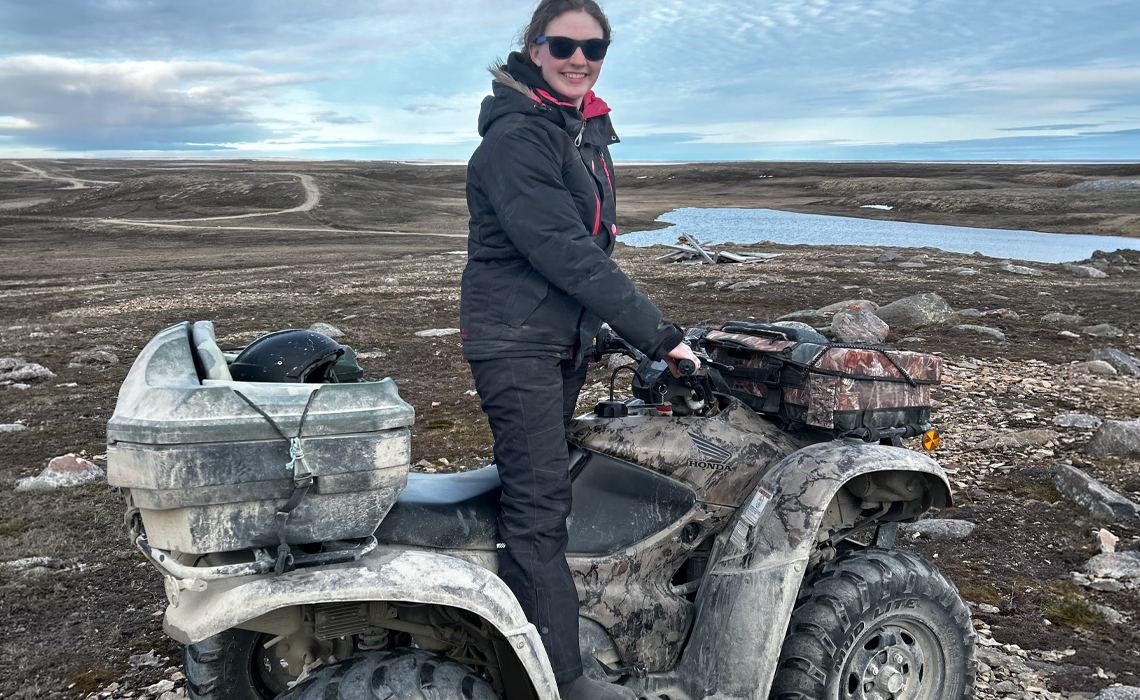
Lawson was also fortunate enough to have won an internship working at the Canadian High Arctic Research Station in Nunavut, assisting a scientist studying cold genes in insects.
“My favourite moments while working in Nunavut would have to be getting to meet all the visiting researchers. While I may not have been able to contribute to a conversation, hearing these established individuals with different backgrounds talk about their research was really insightful.”
Lawson writes about her internship experiences in the Faculty of Science’s publication Science Sphere.
While MRU faculty undoubtedly gave her a helping hand in gaining additional experiences, Lawson’s success is also due in part to her go-getter attitude.
“Ashley really made the most of her degree by taking advantage of the opportunities available to students. Each led to more opportunities for Ashley,” Hill says.
“I’d rather try and get rejected than never try at all,” Lawson says, but she concedes that she likely also had a little bit of luck on her side.
“I say that like it’s nothing, but I do think that it’s quite valuable to highlight that average students can accomplish the same things, or better, as everyone else, You don’t need to be top of the class, uber smartie pants to be able to experience international research internships or Arctic summer jobs. I was definitely not the sharpest tool in the shed for some classes, which is why I say that.”
She hopes new MRU students can learn something from her story. The main takeaway? Your time at university is entirely what you make it.
“Interested in an exchange program? Go for it! Want to join a club? Do it!” she encourages.
“Each experience at MRU will be different for every student, and I can also promise it’s not going to go the way you expect it to be. Whether that will be good or bad is something I can’t predict, but both will happen, and that’s part of being a student.”
Next, Lawson’s leaping right into her master’s program.
“I'm super excited that Ashley will be a member of James Cahill's lab at the University of Alberta working on the Carbon Action Through Grazing (CAT-G) project,” Hill says.
“The plants of native grasslands co-evolved with grazers like bison, and grazing stimulates their root growth and enhances the carbon storage in the soil. Ashley's master's research will help us understand the connection between grazing regimes, plant root growth and soil carbon sequestration.”
Lawson started her master’s earlier than expected, which means she is still waiting to find out if she’ll be available to return to campus to walk the stage and receive her parchment … not a bad problem to have.
Right now, Lawson thinks she may aim for a career in conservation post-master’s. And with a bouquet of educational experiences in hand, anything is possible.