 MENU


Full-circle science: Alumni returns as professor
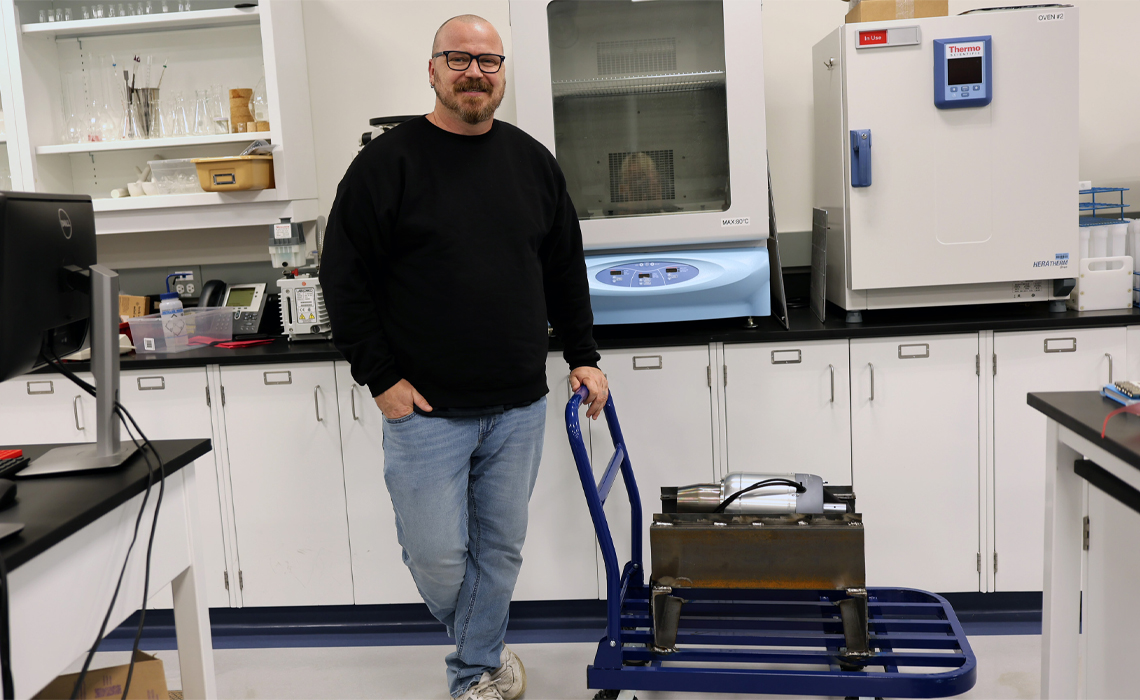
As a humble undergraduate peering down a microscope at Mount Royal less than a decade ago, Dr. Kevin Hayes, PhD, was just beginning to grasp the complexities of environmental science. Today, after completing his doctorate with Manchester Metropolitan University in the U.K., Hayes is back in the same lab — but his view is from the front of the room. As one of MRU’s newest science professors, Hayes proves that the paths opened by an undergraduate degree can open doors to the world … and also bring you right back home.
Hayes graduated from Mount Royal University with a Bachelor of Science — Environmental Science in 2019. He says research opportunities provided through the Faculty of Science and Technology and the chance to work as a research assistant with the faculty’s vice-dean of research and scholarship and professor Gwen O'Sullivan, PhD, helped solidify his future goals.
“I got to do so many cool things as an undergrad. Attend and present at conferences, do real science with real consequences, it was awesome,” Hayes says. Those opportunities led to Hayes being introduced to his future doctoral supervisor and the idea of aircraft contamination leading to potential health consequences in pilots and flight attendants.
As Hayes completed his undergrad just as the pandemic was beginning to take hold around the globe, Hayes was, quite literally, grounded in Calgary.
“I ended up doing the majority of the research work here at Mount Royal in the Environmental Forensics and Arson Lab. I was also able to teach my first classes at Mount Royal as sessional faculty during that time,” Hayes says, proving that scientific inquiry is never bound by institution or geography. Two years ago, he was grateful to land a tenure-track position at MRU.
O’Sullivan says, “I taught Kevin in several classes during his degree program, where I was struck right away by his humble desire to learn. He was obviously very bright and book smart, but his amazing creative thinking was evident right off the bat. This creative thinking, rooted in solid scientific understanding, his humble desire to learn, and reflective practice has made him a pleasure to work at every stage of his career — from classroom to colleague.”
Decoding the air we breathe in flight
Aviation is a growth industry in Canada, and Alberta and Mount Royal are at the controls. Shovels were recently put into the ground for the Alberta Training Centre of Excellence for Aviation and Aerospace, a state-of-the-art facility that will house eight full flight simulators, cabin trainers and other digital learning tools and have the capacity to train approximately 6,000 professionals each year, supporting MRU’s aviation graduates.
Hayes’ research has the potential to improve the health, safety and comfort of everyone on board an aircraft as well as ameliorate the environmental impacts of jet engines on interior and exterior environments.
“I study human exposure to chemicals, so contamination pathways. One of the areas that I focus on is based on a number of different studies regarding pilots and flight attendants. It’s been alleged that those professions have a higher-than-average incidence of neurological injury and illness.”
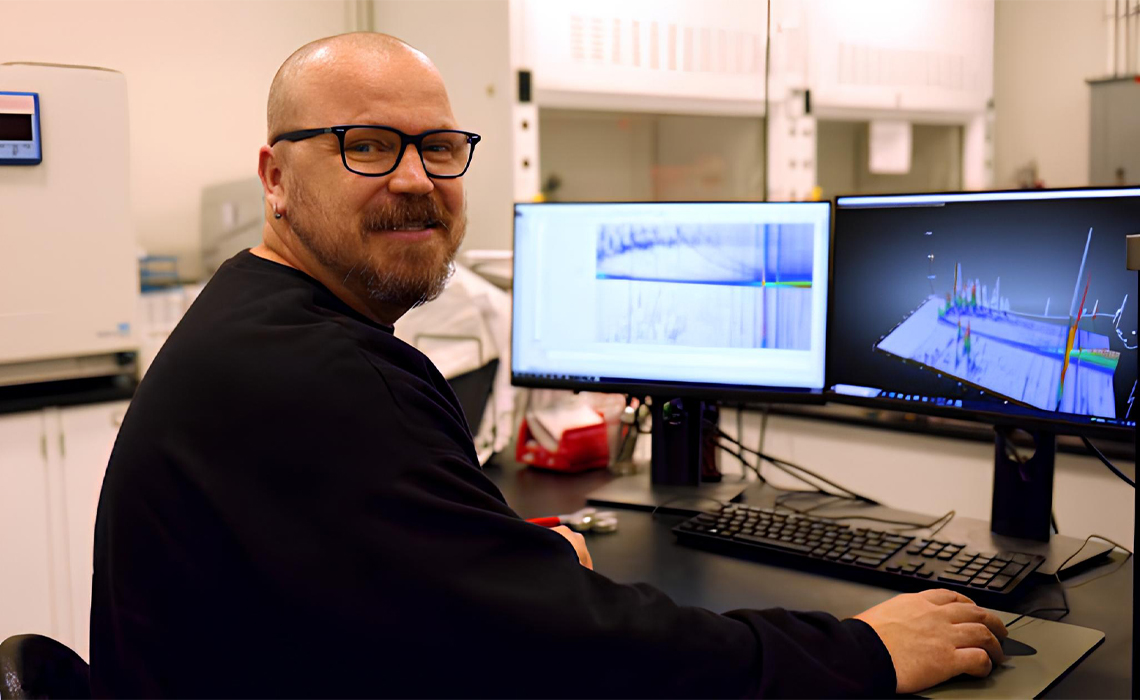
It’s thought those injuries and illnesses might have to do with environmental exposures experienced at work in the aircraft.
“I've done a lot of work with that theory. It's one of those interesting things where most planes are pressurized by air that's pulled in through the engines. That air can become contaminated with what’s in engine oils, and other things connected to the pneumatic system, and make its way into the cabin and potentially cause people to become sick.”
It’s normally very difficult to study an aircraft environment in any depth, as researchers must be invited to an airport and on an aircraft, and it’s also challenging to control experiments, such as what kinds of fuels and fluids are put into the engine and the conditions that engine is enduring. However, due to a capital equipment opportunity in the Faculty of Science and Technology, Hayes was able to request funding for an engine, and was successful.
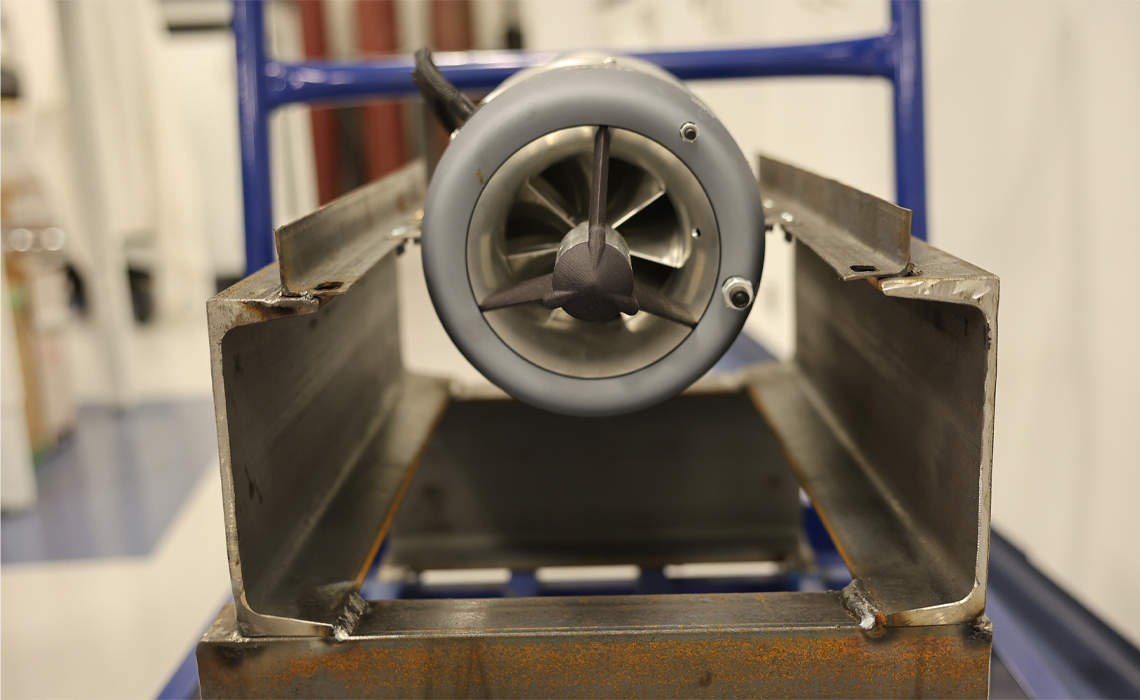
“It’s not a full-sized aircraft engine, but an engine that would be used on a high-performance drone or a really large remote-control aircraft. It can do most of the same things that a real engine can do,” Hayes says.
The difference is that Hayes is able to control factors such as what fuel and oil is used.
“I'm able to change the parameters however I'd like and then sample the air and sample inside the engine and find out what contaminants have been in the really high temperature and pressure environment.”
The injuries and illnesses flight workers experience have nondescript, non-distinct symptoms, but lead towards neuropathy, including tingling pain in hands and feet. Hayes is trying to understand what can be directly tied to the exposures at work. He is using the same sorts of jet fuel in his research that are used by aviation companies worldwide, as well as dozens of different types of engine oil. The engine is too large, messy and noisy to be run inside, so a safe space outdoors on campus will be used, as well as a custom cart for transportation.
Hayes will be sampling the engine emissions using something called thermal desorption tubes, which are designed for analyzing volatile organic compounds (VOCs) and semi-volatile organic compounds (SVOCs). This technique is often used in air monitoring, industrial hygiene testing and emissions monitoring practices. Sampled air is drawn through the tubes with a pump and the organic compounds in the air get stuck to a sorbent in the tubes, akin to how water is purified when it goes through a Brita filter. The tube is then loaded into an oven and heated up very quickly.
“This releases the compounds that are stuck to the filter and they are introduced into a comprehensive two-dimensional gas chromatograph coupled with a mass spectrometer, which is connected to the oven.”
The tubes can be placed in various locations around the engine to sample things like the exhaust, bleed air and post-operation emissions.
“Bleed air is the pneumatic air that is stripped away and isn't used for the aircraft's thrust. I’m able to sample that, and then once the engine is done operation for that sampling period, I'll also take it apart and wipe the inside of the engine.”
Those “sample pathways” will then be run through the GCGc mass spectrometers in the Environmental Forensics and Arson Lab.
Cutting-edge tools for real-world impact
The Environmental Forensics and Arson Lab is a central component for Hayes’ research, O’Sullivan says.
“It not only provides cutting-edge analytical equipment to study a wide range of contaminants in varying matrices, but more importantly provides a collaborative environment that is central to inquiry that is transformative. The lab also acts as an anchor providing the foundation for supporting and developing external collaborations with academics, industry and government.”
Hayes explains that he and many others complete their research in the lab, the main equipment in which is two flow-modulated two-dimensional comprehensive gas chromatographs coupled with time-of-flight mass spectrometers (GCxGC ToFMS) from SepSolv / Markes Intl.
“These instruments allow us to introduce very complex environmental samples in liquid, adsorbed or gaseous states, and separate out the chemical constituents to the individual chemical molecule. We can then compare these unknown chemical molecules with databases or standards prepared with known molecules to describe the chemical mixture, and in my case, find compounds that may be responsible for human health risk.”
The Faculty of Science and Technology is also looking at incorporating high-resolution mass spectrometry into its scientific arsenal.
“Then I will try to figure out what compounds are made at the really high temperatures and really high pressures inside the engine. The lubricants may undergo a process called pyrolysis. So, we're looking for what is partially burnt up or changed via heat and pressure compounds.”
Pyrolysis is the study of thermal decomposition of organic materials at high temperatures (typically 300°C to 900°C) in the absence of oxygen.
“I'll probably have multiple years of sampling ahead of me with this. There are just so many variables that I can work with.”
“Kevin's research in environmental forensics, and especially in exposomics, is cutting edge. He is creative in his thought process, looking outside the box for solution-driven answers to environmental- and health-related issues. His approach to experimental design and data collection will allow us to move beyond models, to applying real-world data sets to better characterize chemical transformations and quantify environmental exposure in the aircraft cabin,” O’Sullivan says.