Kelly Kaur’s new poetry collection joins a writing journey spanning Calgary to the moon
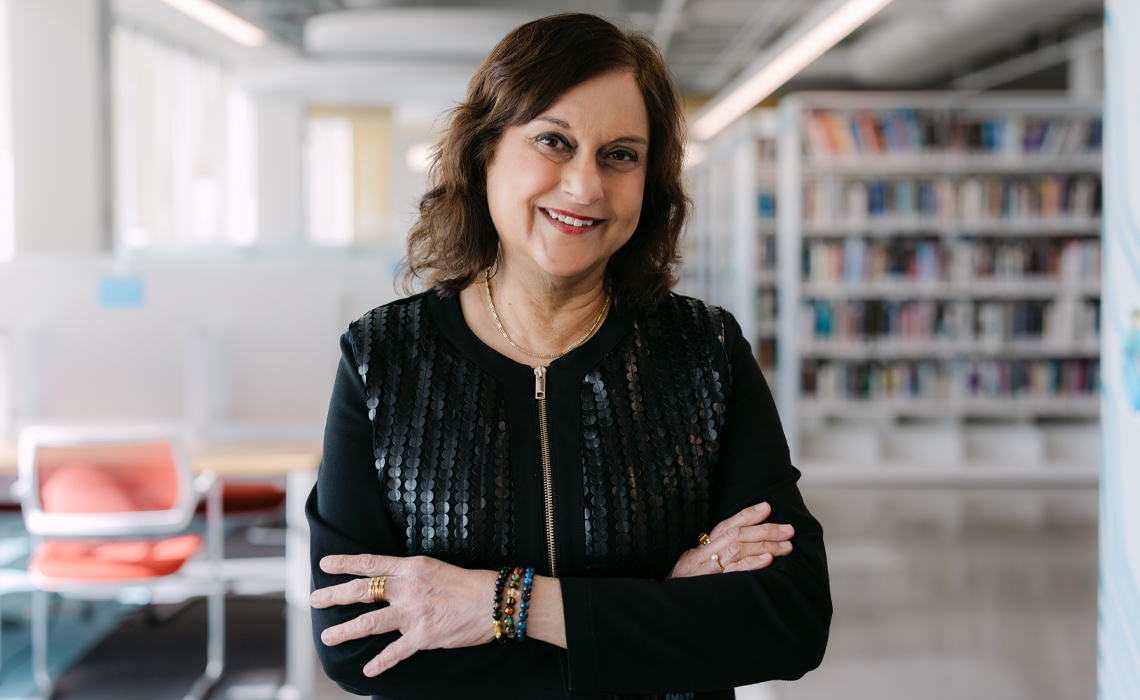
Kelly Kaur encourages anyone who wants to write to take the first step — perhaps a creative writing course — and find what gives them joy as a writer.
Kelly Kaur has been a staple in Mount Royal’s Department of English, Languages and Cultures for over 35 years, guiding thousands of students through the mechanics of academic essay structure and editing. But it’s only in the past few years that Kaur has returned to focusing on her own creative work.
"I had a poem published when I was in university, and then I had many rejections after that, so I gave up," Kaur says. "A few years ago, I decided to not be taken aback by all those rejections. I just started being rebellious and sending things."
The decision to be bold unlocked a floodgate of recognition. Kaur was named one of Canada’s Top 25 Immigrants, and her children’s book, Howdy, I’m Singh Hari, won a 2026 Alberta Book Publishing Award and earned her recognition in the Alberta Legislature for honouring Punjabi Sikh heritage. Her words have also found homes in unconventional spaces, from craft beer cans and art galleries to dance stages and (literally) the moon. Her poem, “A Singaporean's Love Affair,” and debut novel, Letters to Singapore, were selected for space launches with the Lunar Codex.
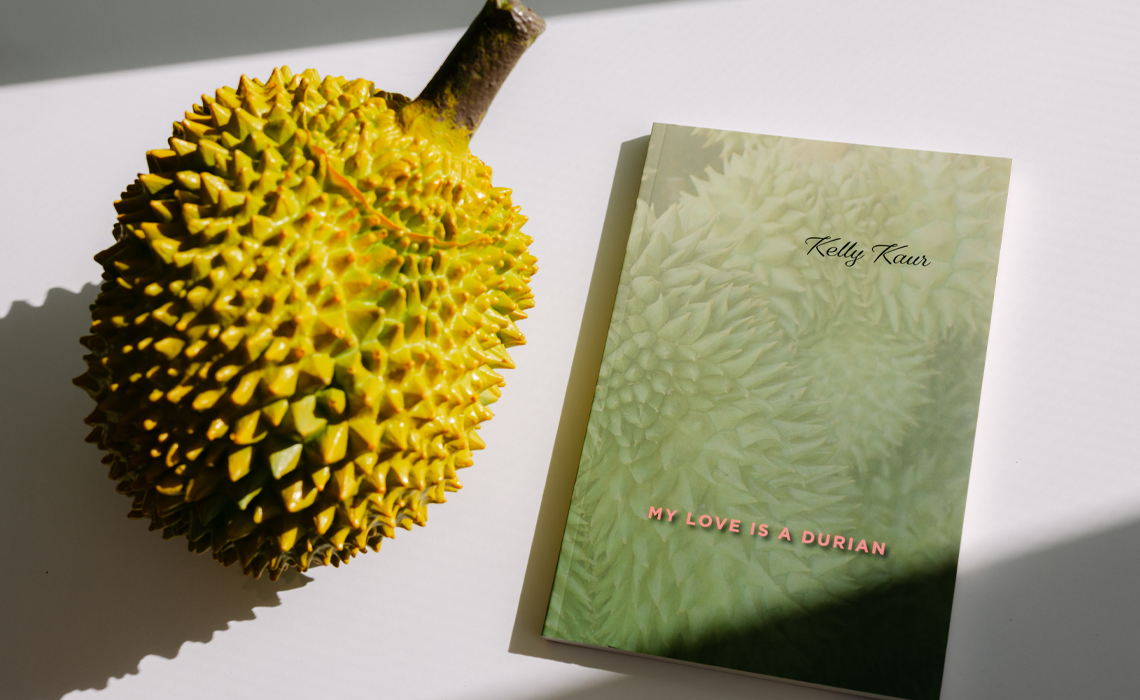
Kelly Kaur’s new poetry collection, My Love is a Durian.
"Kelly’s journey as a writer is a wonderful example of what can happen when you continue to pursue a creative passion," says Dr. Robert Boschman, chair of MRU’s Department of English, Languages and Cultures. "Her work brings important perspectives to readers, and her story is a reminder to our students that it’s never too late to find your voice and share it with others."
Now, Kaur is celebrating another milestone with My Love is a Durian, a vibrant debut collection that CBC Books named one of the Canadian poetry titles it’s excited to read this fall. Blending memories of tropical Singapore markets with the mountains of Kananaskis, the collection explores immigrant identity, womanhood, grief and the search for belonging.
“I didn’t set out to write a poetry collection. I just thought, let’s write some poems and see where they end up,” Kaur says. “I only started this four or five years ago. What if I hadn’t? Thank goodness I didn’t say it’s too late.”
We sat down with Kaur to talk about her new work, finding a creative voice later in life and what it means to send your words to the moon.
My Love is a Durian is a striking title. How did the durian become the perfect anchor for this collection, and how does it reflect the "insider-outsider" dance between Singapore and Canada?
The durian became an unexpected and evocative anchor that I am appreciating as the perfect symbol or metaphor for the insider-outsider dance. The durian is thorny, mysterious and brings out a love-hate reaction from people. Inside this spiky fruit, nestles unexpected seeds surrounded by vanilla caramel custard flesh that may be amazing or rotten. There are so many ways how the durian mimics the Singapore-Canada dance. Immigration experiences can be thorny, challenging, and must be handled with love and care. It takes time to delve into the truth nestled within, and the experiences can be sweet or awful. Whatever it is, this king of fruits is proof that one must not take anything or anyone at face value.
For someone who might shy away from reading poetry or feel intimidated by it, what would you tell them about how to approach this collection and simply enjoy it?
Look at a poem or two within the collection that may resonate with or for you. In My Love is a Durian, I have poems about my Papa who died two years ago at the age of 90. Perhaps, when you read my poems about my father, it may ignite that sense of knowing, similarity, agreement or disagreement about your own father or family. I have four sections in my collection — Singapura: Lion City, Papa, Bedi Rebels and Rising Up. You may find a connection with the themes that are personal yet universal.
Your work deals with deeply personal themes like race, gender and identity. Do you find it difficult to be that vulnerable, or does the need to share those stories make it easier?
It’s harder because I’m personally involved. Suddenly, I’m writing about myself and how vulnerable life can be. And it’s easy because, unfortunately, it’s happening everywhere. So I become the unwilling participant, the unhappy observer, and yet the ironic wisher for things to be better. I protest by writing a poem. I write about how immigrants all share the same dreams and hopes, because at one point or another, we, our parents, or grandparents all came from somewhere. Sometimes, I find it hard because I feel like I'm giving away too much of myself. But on the other hand, you have to be vulnerable to bring compassion and kindness to the page.
You’ve written a novel, a children’s book and a poetry collection. What shifts when you move between forms, and what fundamentally stays the same?
It is an intriguing feel and experiment to move from one genre to the other. I am enjoying the fact that I took the chance in giving voice to each. Poetry is more personal and private. Novels are awesome in that you can use fiction and make things up (or not), and no one needs to know. Children’s books are complex and deserve an approach that can connect with children in special ways. All are exhilarating, frustrating and worth every moment of doing it.
You’ve spoken about starting your writing career later in life as proof that "anything is possible." What do you think is special about finding your creative voice later in life?
I am grateful that I pursued my passion for writing, again, only in the last six years. I seem to be doing things upside down. What I did not pursue in my younger years has now become a quest for the power of possibilities. I am enjoying the outcomes, and this late journey is giving me a new sense of the notion that nothing is impossible. I have three books published, I have done two TEDx talks, I have works on the moon, published on beer cans, danced to on stage in Ottawa, travelled around museums and art galleries in North Dakota, won awards as an immigrant and for outstanding arts and culture, been introduced to the Alberta legislature for upholding Punjabi Sikh culture, am a writer-in-residence for the International Human Rights Art Movement, New York, a mentor … none of these that I could even imagine. I look forward to always being creative and happily pursuing my passion for writing. What next, I ask myself?
Your work is sitting on the moon right now. If a future explorer were to read "A Singaporean’s Love Affair" and Letters to Singapore a thousand years from now, what would you hope they learn about humanity?
The poem "A Singaporean’s Love Affair" has happily landed on the moon. The novel, Letters to Singapore, is slated to go up December 2026. I would love for readers to feel empathy, compassion, understanding and connection: the human desire to belong; the plight of women; notions of immigration; and the human (and alien) quest for belonging. After all, on the moon, these issues may rise again and deserve graceful acceptance.
My Love is a Durian is published by University of Calgary Press and available now.
Order your copy
 MENU


