 MENU


1960 Cougars football team’s dream season
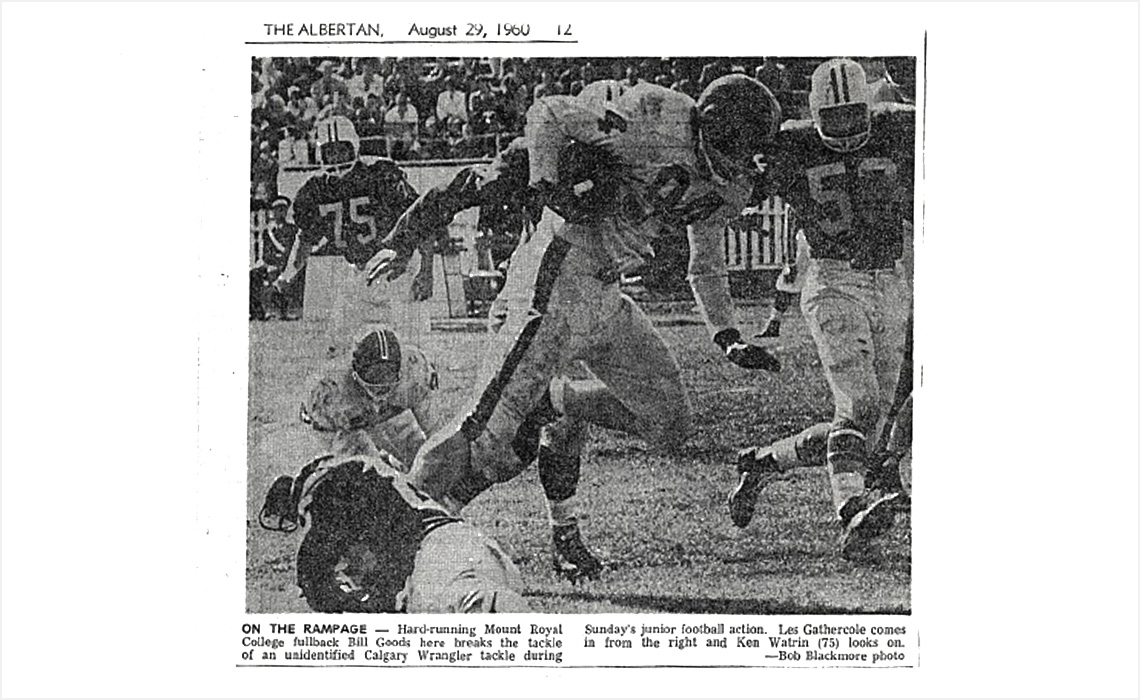
It was an attention-grabbing announcement. In 1960, Mount Royal College, a private school of 850 students, planned to field a football team.
The players will make history as the first Cougars.
Welcomed into the Alberta Junior Football League, the Cougars joined three established outfits, including the powerhouse Edmonton Huskies.
The concept was fascinating, said head coach John Borger in an interview, who pointed out that it was the first time in Canada that junior football and education are being combined. “On this one point alone, I am forced to feel that this is going to be a successful venture.”
His announcement was preserved in a book created for the team’s 40th anniversary in 2000. The commemoration was brought into the Library’s Archives and Special Collections by MRU marketing and communication coordinator Chase Goods, the grandson of Cougars fullback Bill Goods.
Fierce competition awaited the newcomers. The challenge was so steep that, in the interest of fairness, the Cougars were permitted to carry three 21-year-olds — players who were over the junior age limit.
Optimism was in short supply. Calgary Herald sportswriter George Bilych noted, somewhat gently, that “the chances of success in this first season of operation are on the slim side.” An Edmonton columnist scribbled that the Cougars were being “laughed off as weak sisters.”
Which summed up the opinions of everyone in the province.
Well, nearly everyone.
When you know … you know
Confidence in the Cougars’ locker-room was brimming. “I had played enough football to know that we were going to be one hell of a team,” recalls linebacker Moe Martin, now 85 years old. “We had guys who were great players at their high schools.”
Sweating through gruelling practices in preparation of their launch, the squad couldn’t help but notice that they had an abundance of talent, including a gridiron dynamo named Larry Robinson. If no one else believed in them, who cares?
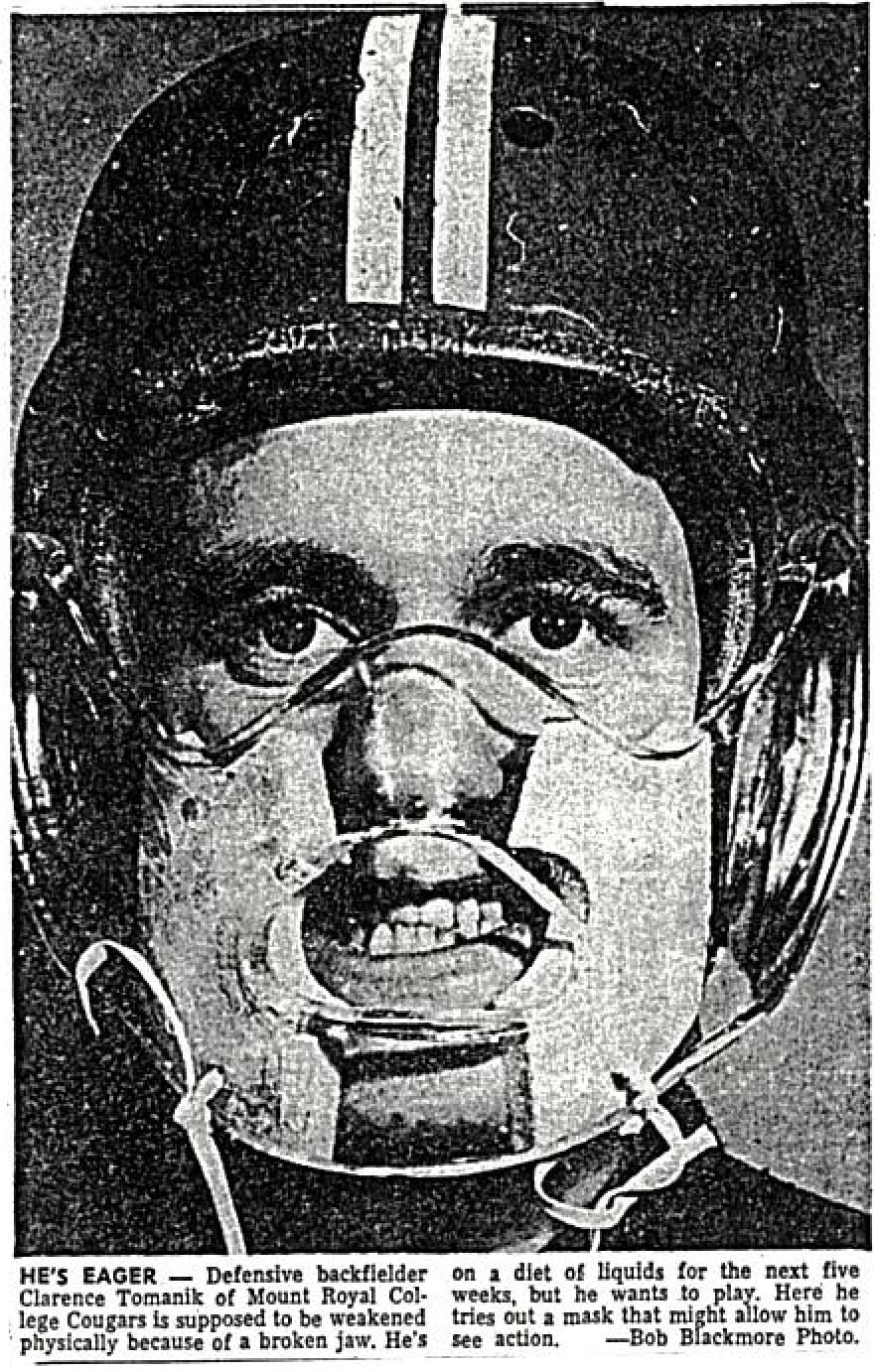
“They just thought we were a young team and we weren’t going to go anywhere,” says defensive halfback Clarence Tomanik, 85. “We barely knew each other, but it was unreal the way that team came together.”
For their Aug. 28, 1960, unveiling, the Cougars tugged on white uniforms with red trim, the get-ups courtesy of the Canadian Football League’s Calgary Stampeders. In no mood for mercy, they clobbered the Calgary Wranglers 45-1 in front of 1,500 spectators at Mewata Stadium, not far from Mount Royal College’s downtown campus.
Quickly — and with pad-popping authority — the Cougars began to show the fans, the city, the league, exactly how strong they were. (Taking notice, the league quietly rescinded the team’s allowance of overaged players.)
Unstoppable
Eight weeks — and seven wins — after their one-sided debut, this time with a crowd of nearly 12,000 in the bleachers, the Cougars edged the Huskies 33-32 in dramatic fashion to capture the AJFL crown. By then, doubters were scarce.
“Incredible. Unbelievable. Amazing. None of the adjectives in the book of Webster can do justice to what transpired at Mewata Stadium,” Bilych typed enthusiastically after witnessing the hosts rally from a 25-0 deficit. “It was an effort that defies description.”
Thanks to that heroic display, the Cougars became the first Calgary representatives in six years — and the youngest in league history — to rule the province. “Junior football teams in Calgary, for years, weren’t doing well,” Tomanik says. “All of a sudden, this team out of the blue, a bunch of kids, was playing great football. Mount Royal was getting written up in the papers every day. Calgary had something to root for.”
After their stunning triumph over the Huskies, John Short, columnist of The Albertan newspaper, wrote: “Nobody on that club is old enough to understand tradition, but they all understand that they’re building it. They’re doing things in the name of sport that they wouldn’t be asked to do anywhere else. This is not a team of all-stars — it is a team of eager kids who don’t know how to lose.”
The remarkable campaign continued.
Performing at a brand-new McMahon Stadium, the Cougars blasted the Vancouver Blue Bombers 33-8 to lay claim to Alberta-B.C. bragging rights. Their ticket is now punched to the Western Canadian showdown against the highly touted Saskatoon Hilltops.
“There is a growing feeling hereabouts that despite Mount Royal’s infancy in football’s family, they can go all the way to the Canadian championship,” wrote Keith Matthews, another columnist in the city. “Let us see what brings these hairy-chested hopes to the surface.”
Just short of the peak
Alas, on a snowy pitch in Saskatoon four days later, the clock stuck midnight on Calgary’s Cinderellas.
Crushing the hearts of the battered Cougars — who were missing five first-stringers and deploying several hobbled starters — the Hilltops prevailed 23-0. “A group of gallant schoolkids said farewell to a dream,” Short wrote. “This may read a little heavily, I guess. But it isn’t every day a dream dies.”
With moxie, though, these pioneers carved out a patch on the city’s sporting landscape. This is years before the birth of the University of Calgary’s football program, and the Cougars seemed to be gaining traction.
“We were expecting the world — and we pretty much got it,” says Keith Hembroff, 85, an all-star offensive guard. “Mount Royal being new at the time, the Edmonton Huskies being the heroes of the world, the Saskatoon Hilltops being the heroes of the universe, those were the things that drove us.”
The Cougars’ sudden prominence was worthy of celebration. And, sure enough, the school dedicated the 1961 yearbook to them: “If any one single event deserves to be selected as the year’s most significant, it is certainly the creation of the Mount Royal Cougars football team, and its terrific showing in Canadian Junior Football. The dynamic spirit of this group spread beyond the walls of the College to fan the spark of Junior Football interest into a roaring blaze of enthusiasm …” the yearbook reads.
Following its 1964 campaign, however, Mount Royal College’s football program — the victim of budget cuts and the loser of four straight AJFL finals to the Huskies — is gone, opening the door for the junior emergence of the Calgary Colts.
But the Cougars’ first year manages to live on.
Through, for instance, the continued excellence of their alumni. Robinson, in 1960, is the AJFL’s top rookie and most valuable player. The following year, as a Stamps standout, he is the CFL’s top rookie. It’s the start of a hall of fame career. Asked to describe Robinson’s ability, Martin uses the word “unbelievable” — three times in a row.
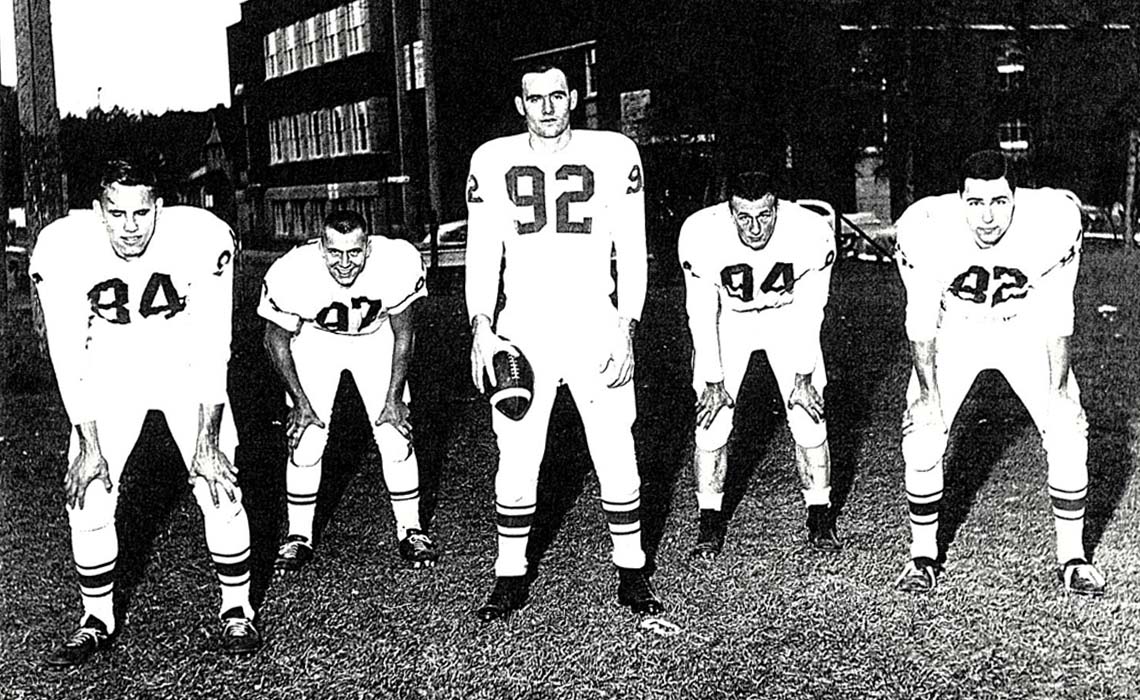
Others — such as Gerry Shaw, Trev Ekdahl, Bill Goods, Barry Randall — will also play pro, while many, including Hembroff, land U.S. college scholarships, thanks to the stage that the Cougars provided.
Also leaving a memorable mark is Borger, the notoriously hard-nosed boss. “Kids don’t like being pushed by the coach, so they get together and say, ‘We’re going to show him,’” says Hembroff. “That’s what happened that year. Borger was a taskmaster, no question — and it made us all better.”
When the Cougars fell into a 25-point hole early in the AJFL championship against the Huskies, Borger’s half-time touch was masterful. “He never gave us hell,” Tomanik says. “He never ran us down. I remember it was very soft, he said, ‘The best team is losing out there.’ It just clicked. And it was a great comeback.”
Martin, cackling, is keen to share one more nugget about their legacy. And this particular contribution remains in plain sight.
Months before the start of the season, Borger informed the players that they still needed a team name. “I thought, ‘Cougars,’ and I mentioned it to him,” Martin says. “Then when they announced the Mount Royal College Cougars, he didn’t give me any credit.”
Laughing, he adds, “No big deal, but I’ll keep telling people about it.”