 MENU
MENU



An indelible legacy
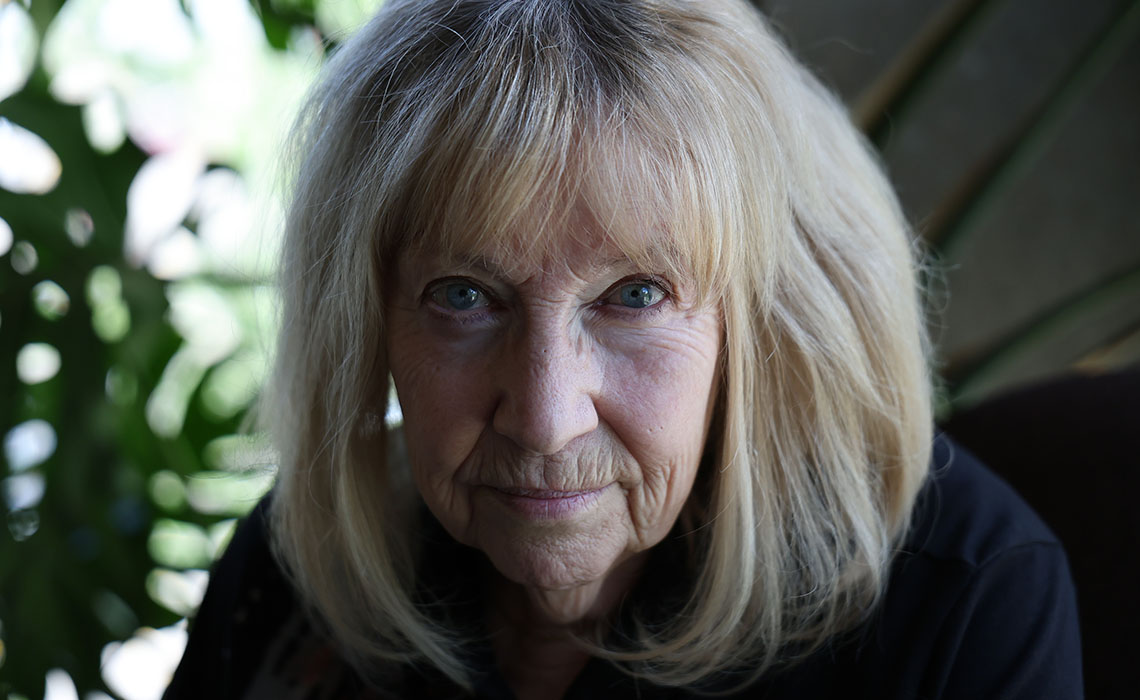
Associate Professor Elaine Mullen started at Mount Royal in 1969, when the campus was located downtown and affectionately known as “The Barn.” The population of Calgary was less than 400,000, and the college served a student body of 2,500.
Obviously, a lot has changed in the 57 years Mullen has been at Mount Royal, and she has played a part in much. One example of her work was her helping to develop the pedagogical aspects used in the planning and construction of the Arts and Bissett School of Business buildings. Mount Royal faculty fought hard to ensure that the new classrooms would only hold between 35 to 50 students in order to keep Mount Royal’s reputation for smaller class sizes.
Over the years, there have been residences, a new Recreation facility, the Students’ Association expansion, an entire library and the Bella Concert Hall built. Art has been installed, landscaping designed, trees planted and trees gone.
Through all this growth and change, there has been an interesting constant, however, and that is the 60-year-old philodendron plant (now thriving in the arts faculty’s coffee room) that Mullen has been taking care of since 1972 when she took up residence at Mount Royal’s ultra-modern new Lincoln Park location in the middle of the old RCAF military airfield.
“I remember the first day I arrived at the new campus, I couldn't find the front door,” she says. “So I came in through the loading docks at the back. Apparently, I wasn't the only one.”
The Lincoln Park building was designed by the Calgary architectural firm Stevenson Raines and based on the Leggett educational model, named after architect Stanton Leggett, who advanced influential ideas about open-plan learning spaces and community-focused school design.
“We found that the open area classrooms were a very bad concept,” Mullen jokes. “The idea that anybody could walk into a classroom and sit down and enjoy a lecture by whoever was giving a lecture was part of the pedagogy, but it didn't work well.
“Everybody smoked in those days. They had ashtrays through all these open area classrooms and offices. You could look out over this vast area and see smoke rising everywhere.”
There was noise, interruptions, no doors. Mullen, who was hired as an educational psychologist after attending the University of Alberta, says, “To counsel a student in an open area, what kind of privacy is that?”
There were no photocopiers, and of course no computers: there were Gestetners, landlines and electric typewriters. In the E-Wing, there was a convenient Royal Bank with a fountain in front of it, a barber shop and a popular soup kitchen. And there was Mullen.
“I was hired into the counselling department as a contract instructor to establish the Learning Skills Program, which has evolved into today’s Student Learning Services.” Student services was a new concept being established all over North America in universities and colleges, putting Mullen at the forefront of another new concept, a trend that continues through her life in education.
When Mount Royal’s English department needed an instructor, Mullen was hired, teaching sessionally there for nine years and gaining a full-time position and tenure in 1978.
“The English department has been historically a very strong department at Mount Royal,” Mullen says.
She has taught many upgrading courses, plus fiction, but the Romantics and poetry, and language learning and composition are where her heart is. Mullen also taught at Red Crow on the Kainai Nation and on the Stoney Nakoda First Nation when Mount Royal was one of the first and only colleges to form affiliations with Indigenous schools — relationships retained today.
“Now I'm largely teaching composition, critical thinking and rhetoric. I love teaching. I'm still here because of the students.”
Teaching and learning
Mullen’s degrees are in education, psychology, and English, the perfect trifecta for expertise in teaching and learning.
“I bring all of those to help students learn how to think about things, to encounter new information, to decide how it fits into their lives and how it makes society work or not work. For me, education is about helping students expand their abilities to think critically.”
Mullen’s personal pedagogy is based on brain-based learning.
“Multimodal high-sensory input is important. Just sitting and reading, a person learns a little bit. Reading and writing, you learn more, but experiencing high-sensory, multimodal input is what really helps us remember things. We don’t learn well from just cutting and pasting.”
To Mullen, teaching is highly personal, based on the kinds of relationships set up with students to understand their context and where they are coming from, and about how to help them take advantage of the learning opportunities in front of them.
“I tell my students at the beginning of the course, ‘I hope that by the end of this semester, you will all be happy, thoughtful, highly skilled skeptics.’ ”
Commitment to fellow faculty
Among the many internal and external awards Mullen has received over the years, she is happy to have received the Distinguished Faculty Teaching Award in 1990 and the Mount Royal Faculty Association’s (MRFA) Distinguished Service Award in 2017 in recognition of her many contributions to Mount Royal including serving as the elected MRFA faculty representative to the Board of Governors for four years and the member at large for the MRFA Executive Board for two years. Indeed, she has sat on and chaired too many committees to list here.
In 1996, Elaine was seconded from the English department to serve as the faculty development coordinator in the Academic Development Centre, where she worked for 18 years before returning to the English department.
In addition to serving on too many committees to count, another of Mullen's successful contributions to Mount Royal was her development of the Instructional Support Program for new faculty. This was a three-year mandated programme designed by Mullen and endorsed by the vice-president, Academic at the time.
One of her favourite achievements, however, is the creation of the MRFA’s Annual Spring Retreat. In 1998, Mullen had a small professional development budget to bring a speaker to campus. Instead of doing that, she decided to organize her own inclusive Mount Royal conference at the Stoney Nakota Lodge and Conference Centre.
“The speakers and presenters were drawn from our own faculty. At four o'clock we'd take a break and have fun sessions where you could join a climbing or hiking group led by one of our geologists, or do a drawing or watercolor workshop led by our own interior design faculty. This retreat is still popular today.”
Another program still active is called the Triads, where three professors from different departments get together for a year or a semester and talk about teaching.
“It's very successful. It's a really good program,” Mullen says.
In 2014, Dr. Jennifer Pettit, PhD (now dean of the Faculty of Arts) took over the faculty retreat responsibilities. She says, “With many years of service to Mount Royal College and then Mount Royal University, Elaine has been a consistent contributor and has had a significant influence on MRU. Having worked at the university for several decades, Elaine has both witnessed and helped guide the evolution of Mount Royal and the Faculty of Arts. Elaine’s influence is woven into the very fabric of our academic community. Her deep institutional knowledge is often called upon and serves as a compass for the Faculty of Arts and beyond. Her enduring passion for teaching continues to inspire everyone around her, and beyond the classroom, Elaine’s advocacy for colleagues has forged the very sense of community that defines the Faculty of Arts. She is truly one of a kind, and we are incredibly fortunate to call her a colleague.”
Retired professor emeritus and colleague Richard Harrison, PhD, says, “Elaine always has time for you, and the older I get the more I know how precious that is. But Elaine always stops and talks. Not just about university stuff, but personal things if you wanted a kind ear to listen, a caring thought in reply. And she’d remember what you’d talked about, even after you’d forgotten. She’d arrive in the lounge in winter and say, ‘Richard, about what you were saying last spring …’ ”
The question of retirement is always being asked, but Mullen still climbs the three flights of stairs to her office quite easily.
“I love what I'm doing, and I've got the energy and the health,” she says.
Mullen tells of an incident she had with a former president of Mount Royal College, Tom Wood (1993 to 2002). Wood received an Honorary Doctor of Laws during the 2025 Convocation ceremonies.
Mullen says Tom told her this story at his retirement party: “ ‘You know, Elaine, my father told me that when you come to work in an institution, it's like the institution is a pail of water, and you put your hand into the pail of water. And when you retire, you pull your hand out of the pail of water, and nobody even knows you were there.’ And I thought that was really wise because it's true.”
In many cases, that may be true. But in Mullen’s it certainly isn’t.