 MENU


Splash down at MRU
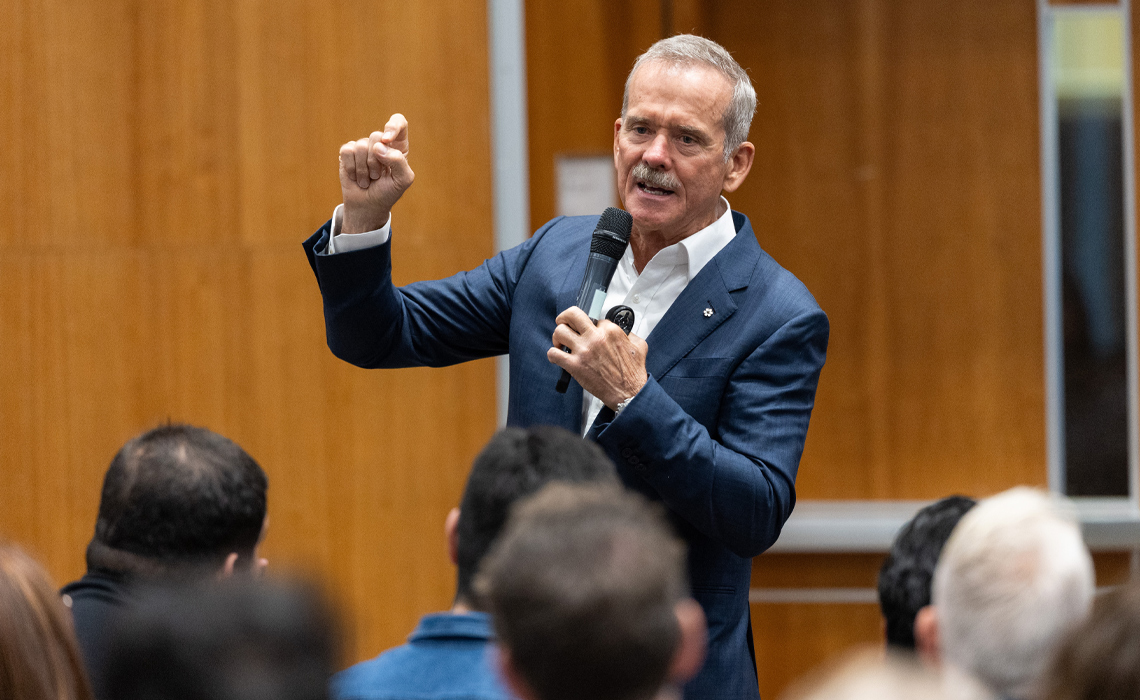
On Oct. 6, close to 400 students, employees, faculty and community members descended upon Mount Royal University’s Ross Glen Hall for an afternoon with renowned astronaut, Colonel Chris Hadfield. As part of the Bissett School of Business’s Exceptional Speaker Series the event’s title was Leadership & Sustainability — An Astronaut’s Mindset and took place during MRU’s Sustainability Week.
“When the Bissett School of Business set out to bring extraordinary Canadians to the stage at Mount Royal University, Colonel Chris Hadfield was immediately at the top of our list,” said Kelly Williams-Whitt, dean of the Faculty of Business, Communication Studies and Aviation. “As the first Canadian to command the International Space Station, his remarkable leadership, resilience and vision made him the perfect choice to inspire our community.”
Hadfield is one of Canada’s most celebrated astronauts and aviators, marked by a distinguished career in both military flight and space exploration. As a Royal Canadian Air Force colonel, fighter pilot and top-rated test pilot from 1978 to 2003, he is well-known for being the first Canadian CF-18 pilot to intercept a Soviet bomber in North American airspace. Over three missions and 166 days in space, Hadfield became the first Canadian spacewalker, performing two spacewalks to install Canadarm2 on the International Space Station (ISS). He also operated the space shuttle's robotic arm to attach a docking module to the Mir space station. Despite those achievements, it was Hadfield’s breathtaking photos of the Earth, his innovative use of social media and his viral weightless cover of David Bowie's "Space Oddity" aboard the ISS that solidified his position in the hearts and minds of his fellow Canadians.
“We thought Chris Hadfield would be the perfect speaker — he was the first Canadian commander of the International Space Station, leading an international crew of astronauts. He has so much experience leading teams through complex environments characterized by a lot of change,” said Leah Hamilton, vice-dean of research and community relations for the Faculty of Business, Communication Studies and Aviation.
MRU’s chancellor, Arlene Strom, introduced Hadfield, noting his many awards and accolades, including NASA’s Exceptional Service Medal and Canada’s Meritorious Service Cross (twice). He is also an officer of the Order of Canada, serves as a director and advisor to tech companies, including SpaceX and Virgin Galactic, and assists King Charles III with space business practices for his sustainable markets initiative. He also co-founded the space stream at the Creative Destruction Lab, which has created $16 billion of new business in equity value in the last five years, and is a best-selling author.
“As Canada's most accomplished astronaut, Chris Hadfield has gone farther and faster than almost anyone in the world,” she said.
How do amazing things happen?
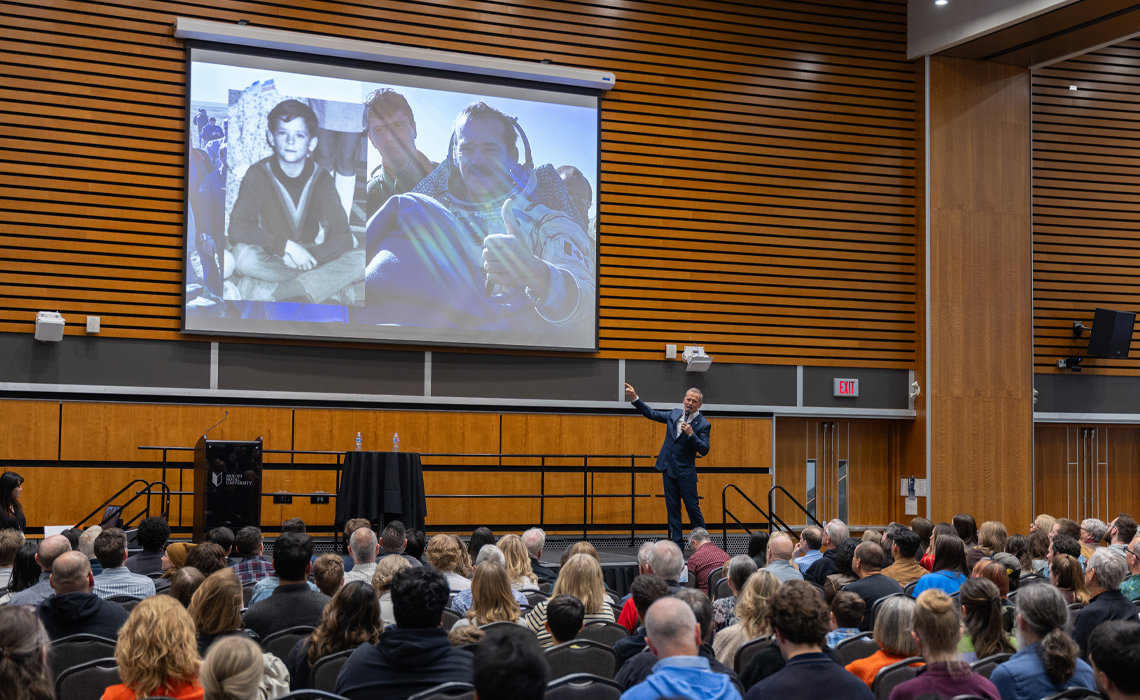
Hadfield began his talk by sharing a photo of him in Grade 5 when he was reading classic science fiction and watching Star Trek. He dreamed of going to space, but could not fathom how that could happen … until the Apollo 11 mission in 1969. The Soviets had been very far ahead of the U.S. in the space race, but Americans had somehow managed to be the first to land on the moon.
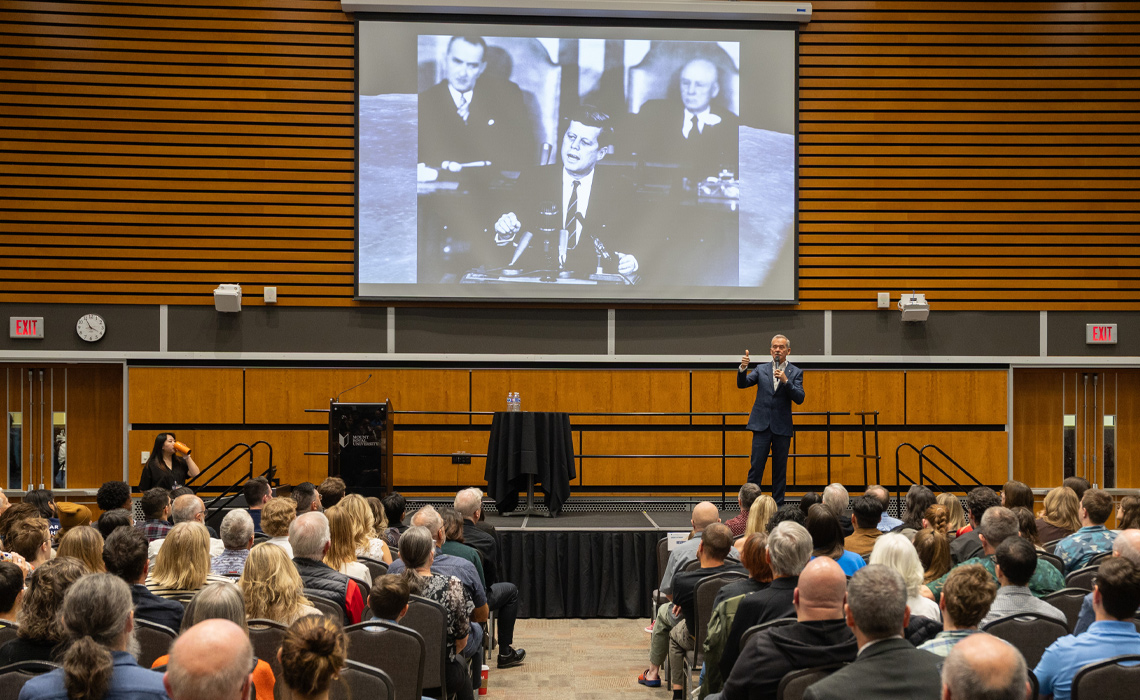
“What it took was leadership, a weird confluence of technology, an absolute audacity of leadership on behalf of this guy, the leader of the U.S. at the time,” who was John F. Kennedy, Hadfield said.
“We need leaders who have hopefully enough experience in their life to be able to confidently set us on a path to accomplish something.”
Although Canada didn’t have a space program of its own, Hadfield set himself on a path to get as close to orbit as possible; earning his degrees, joining the Royal Canadian Air Force and working with the United States Air Force as a test pilot. Eventually, his opportunity would emerge with the advent of the Canadian Space Agency.
While commanding the ISS, Hadfield drew on a career of leadership study, for which, to him, there are four principles: Purpose, Skills, Communication and Celebration. A team must always be working towards something, developing their own expertise, and continuously speaking with each other.
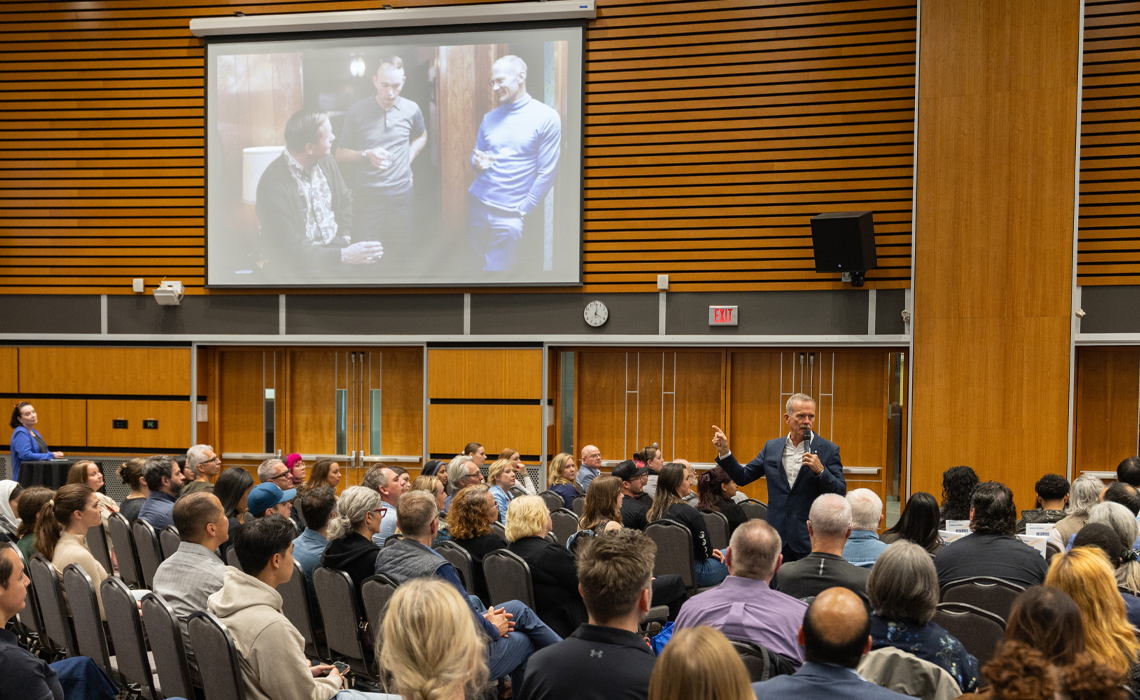
In addition, “Don't wait until landing day to celebrate. Try and celebrate every single day,” he said.
The ISS is also a good example of sustainability, as it is a completely closed system, just like life on Earth. It is up to leaders to ensure a good quality of life within those systems, Hadfield said. Humanity has made great progress in improving well being and extending lifespans, however population growth is placing extreme strain on the planet. There are a lot of complicated questions facing those on Earth, but what is required are strong governing structures, Hadfield believes.
And, there just may be hope in space. Hadfield predicts there will be a permanent colony on the moon in the next few years and an opportunity to mine the massive reserves of ice at its south pole.
In conclusion, Hadfield noted that the average person has about 30,000 days on Earth.
“What are you going to do next?” he asked.
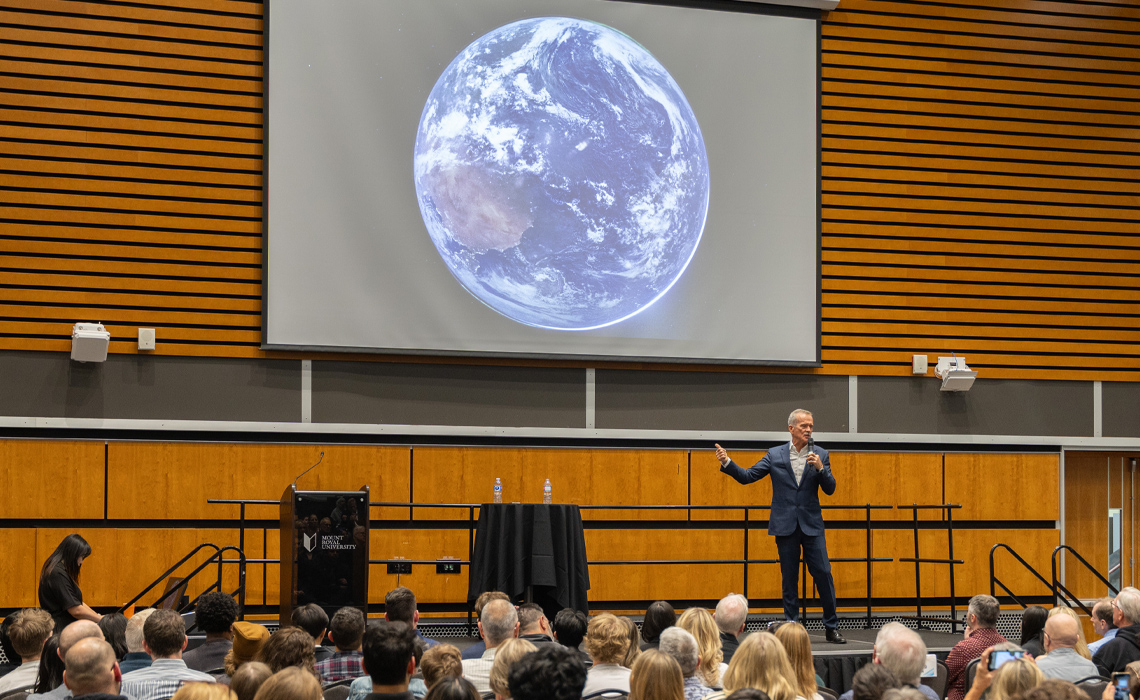
At the end of Hadfield’s talk, the audience had the opportunity to ask questions and have copies of his books (and other items) signed.
Leah Hamilton hopes the experience sparks conversations with colleagues and classmates.
“We are living in times characterized by a lot of uncertainty and rapid change. Climate change and anxiety, rapid technological shifts like AI,” she said. “I hope we feel inspired to work together in a cross-disciplinary way to solve some of the pressing challenges we’re facing, and I’m confident we will learn from some of Hadfield’s leadership principles.”