 MENU
MENU




Inii Awattoo
Buffalo on the Move
Indigenization and Decolonization Strategic Framework
2026 Onward
View as PDFLand Acknowledgement
Mount Royal University is situated on an ancient and storied land steeped in ceremony and history that, until recently, was occupied exclusively by people indigenous to this place. With gratitude and reciprocity, Mount Royal acknowledges the relationships to the land and all beings, and the songs, stories and teachings of the Blackfoot, the Tsuut’ina, the Îethka Stoney Nakoda, and the Métis.
Read MRU’s full land acknowledgement
Upholding ethical space
At Mount Royal University, we recognize the deep harms caused by colonization, including the genocide of Indigenous peoples and the legacy of trauma inflicted by residential and public education systems, including universities. Since our first Indigenous Strategic Plan was developed in 2016, the University has been on a journey toward indigenization¹ and decolonization², and is committed to addressing this legacy of harm in both word and action.
Learn more about ethical spaceOur guiding principles
The following guiding principles are rooted in Indigenous worldviews and build upon Mount Royal’s core values of transformation, belonging, boldness, inquisitiveness and authenticity. They reflect our shared responsibility to approach indigenization and decolonization with care, reciprocity and respect.
- Ethical space
- Relationships and reciprocity
- Decision-making
- Oral traditions and pedagogies
- Values, protocols and ceremony
- Shared responsibility
- Holistic approach
- Learning and transformation
- Relationship with the land
Together, we will:
Practice working in and upholding ethical space, where Indigenous and non-Indigenous ways of knowing, being and doing are valued, engaged with respect, and meaningfully integrated into university life.
Prioritize relationships and reciprocity in all indigenization and decolonization efforts, recognizing that transformation happens through trust, meaningful engagement and shared responsibility.
Engage in decision-making that respects Indigenous consensus- building, ensuring that all voices are heard and that we take innovative, Indigenous-led approaches to decolonization and systemic change.
Establish, develop and validate Indigenous oral traditions and pedagogies, such as storytelling and land-based learning, as ways of teaching, learning and relationship- building to ensure that knowledge is shared ethically and with respect for its origins and responsibilities.
Embed and integrate Indigenous values, cultural protocols and ceremony into university life in ways that hold cultural and community significance.
Activate and live out our shared responsibility to uphold the spirit and intent of the treaties.
Apply a holistic approach to indigenization and decolonization, ensuring Indigenous knowledge and ways of knowing, pedagogies, perspectives and realities are integrated across curriculum, governance, policies and campus life.
Commit to continuous learning and transformation, recognizing that indigenization and decolonization require ongoing reflection, accountability and adaptation.
Engage in a relationship with the land as a living web of relationships and territory that we nurture and sustain, and from which we learn.
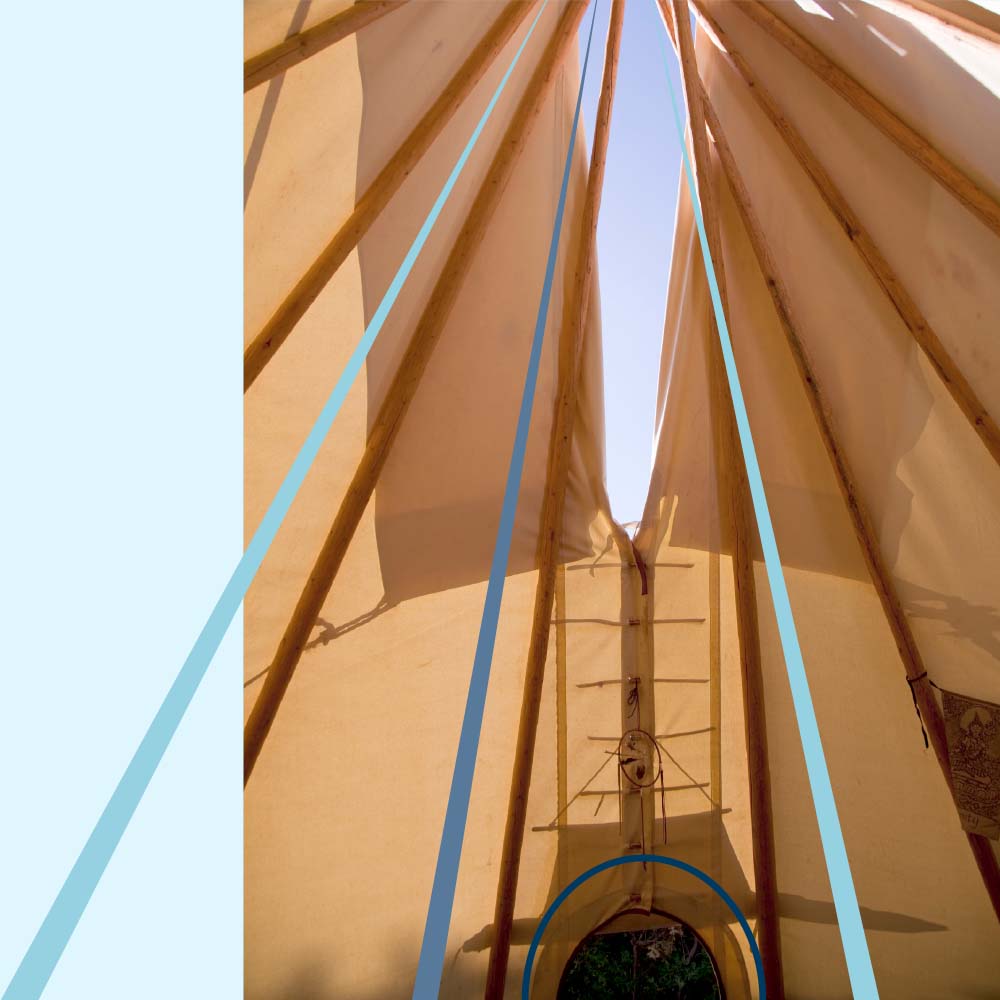
The Blackfoot lodge as a living model for strategic planning
Gifted to Mount Royal University by Elder Miiksika’am, the Blackfoot lodge is a living model that guides strategic planning work across the University to advance indigenization and decolonization. It is grounded in teachings about the lodge’s structure, spirit and relationship with the universe.
Learn more about the living modelHonouring and caring for the lodge
As a university community, Mount Royal is called upon to uphold the lodge model entrusted to us by Elder Miiksika’am.
Inii Awattoo is not a strategic plan with centralized accountability or a prescribed set of actions and timelines for a given unit. Instead, it is a strategic framework that offers a shared foundation to guide all units (and individuals) in their own planning efforts by empowering leaders, faculty and staff to engage in ways that are most meaningful, suitable and sustainable for their respective areas.
While every element of the lodge holds meaning, the foundational poles and the lodge fire are especially important for guiding us all in planning and implementing this work.
The responsibility for advancing indigenization and decolonization resides within all areas of the University.
Foundational poles:
Our strategic priorities
In a Blackfoot lodge, four foundational poles are used to create the structure. These poles are not interchangeable; each one has a distinct purpose, placement and direction. Together, they uphold the lodge, allowing the fire at its centre to burn brightly.
In the Inii Awattoo framework, the four foundational poles represent four categories that house the six strategic priorities, honouring the original teachings of the lodge while identifying the areas of focus for Mount Royal in our strategic planning across the University:
Foundational pole 1
Indigenous student success
Foundational pole 2
Transformative education
Foundational pole 3
Indigenous oral traditions and pedagogies
Foundational pole 4
Reciprocity, consensus and shared responsibility
While the lodge poles represent the strength of our commitment to indigenization and decolonization, the lodge fire symbolizes the vitality of the framework; it is perceived as alive and interconnected to its environment. The activities, initiatives, collaborations and practices undertaken at Mount Royal represent the fuel needed to bring the framework to life and sustain it for years to come.

By tending to these strategic priorities together as a community, we feed the fire that keeps the lodge warm, vibrant and alive.

Continuing our journey
Mount Royal has been committed to indigenization and decolonization since its first Indigenous Strategic Plan was activated in 2016. Our progress is reflected in our community partnerships, academic programming, ceremonies, campus supports and institutional plans enacted across the University.
This work is ongoing.
Inii Awattoo builds on our past and existing efforts and continues the journey, offering shared priorities and ideas for activities and initiatives to support continued progress.
Take action and feed the fire
Divisions, departments, teams and units across Mount Royal are accountable for advancing indigenization and decolonization. Follow these steps to get started:
- Read Inii Awattoo.
- Identify the strategic priorities that align best with the work of your unit or team.
- Work with your unit or team to gain an understanding of Indigenous perspectives and realities to inform your planning of actions and/or initiatives.
- Plan your actions and/or initiatives. Initiatives should respond to the guiding principles and strategic priorities in Inii Awattoo, in their development and implementation. This work might involve partnerships with Indigenous faculty, staff, students or community members.
- Integrate initiatives in strategic plans, as appropriate.
- Reach out to the Office of Indigenization and Decolonization for questions.
- Take action.

Indigenization and Decolonization Strategic Framework Committee
Inii Awattoo reflects the collaborative work of the Indigenization and Decolonization Strategic Framework Committee, a cross-institutional group of Indigenous and non-Indigenous faculty and staff, guided by Elder Miiksika’am. Mount Royal thanks each member for bringing their knowledge, care and critical perspectives to this work. Their contributions helped create a foundation that reflects both where we are as a University and where we need to go.
Committee members
- Miiksika’am – Elder Clarence Wolfleg
- John Fischer, Interim Associate Vice-President, Indigenization and Decolonization
- Tori McMillan, Director, Iniskim Centre
- Karim Dharamsi, Vice-Provost Academic
- Shannon Faubert, Administrative Assistant to the Associate Vice-President, Indigenization and Decolonization
- Audra Foggin, Associate Professor, Faculty of Health, Community and Education
- Christopher Grignard, Assistant Professor, Faculty of Arts
- Jennifer Pettit, Dean, Faculty of Arts
- Evelyn Poitras, Ptarmigan Charitable Foundation Chair in Indigenous Business and Economic Development
- Stephen Price, former Dean, Faculty of Health, Community and Education
- Kimberly Smith, Research and Planning Consultant, Institutional Research and Planning
- Linda van der Zande, Director, Office of the Provost
- Gabrielle Weasel Head, Associate Professor, Faculty of Arts
End notes
Glossary of terms
The following terms are provided to support shared understanding of concepts referenced throughout this framework. They reflect how these ideas are used in this context and are offered as a starting point for ongoing learning and dialogue.
1. Indigenization
Indigenization involves centering Indigenous perspectives, knowledge and experiences in a university’s programs, policies, and practices. It includes creating space for Indigenous worldviews to shape decision-making and teaching, while supporting Indigenous students, employees and communities in ways that honour their identities and goals.
2. Decolonization
Decolonization is the process of identifying and changing policies, structures and practices rooted in colonial systems. In a university context, this can mean addressing power imbalances, challenging assumptions embedded in Western paradigms and working toward more equitable relationships with Indigenous peoples and ways of knowing.
3. Transformation
In the context of this framework, transformation refers to the deep and ongoing personal, institutional and societal changes required to uphold Indigenous ways of knowing and being. As Blackfoot scholar Betty Bastien describes, transformation begins within the self — through reflection, humility and relationship — and extends outward to challenge colonial structures and create more ethical, reciprocal systems. It is not a one-time shift, but a continual process rooted in Indigenous values and guided by responsibility to future generations (Bastien, 2016).
4. Ethical space
Ethical Space is the idea that when people from different worldviews come together, they enter a shared space that requires mutual respect, responsibility and relationship-building. Initially introduced by Cree scholar Willie Ermine, ethical space provides a way to navigate differences without domination, inviting collaboration that honours both Indigenous and non- Indigenous ways of being and knowing (Ermine, 2007).
5. Western knowledge systems
Western knowledge systems typically reflect academic traditions shaped by European philosophies and colonial histories. These systems often prioritize written texts, standardized methodologies and individualism. While they are not monolithic, they have historically been positioned as dominant within universities, sometimes at the expense of other ways of knowing.
6. Indigenous knowledge systems
Indigenous knowledge systems are diverse, land-based ways of understanding and engaging with the world. These systems are rooted in community, relationality, oral traditions, lived experience and spiritual dimensions of knowledge. They include ways of teaching, learning, governing and relating to all living things.
Further information
Download Inii Awattoo, Mount Royal University’s Indigenization and Decolonization Strategic Framework
View as PDFFor more information about Inii Awattoo or to order print copies, please contact:
Office of Indigenization and Decolonization
References
- Bastien, B. (2016). Indigenous pedagogy: A way out of dependence. In K. Burnett & G. Read (Eds.), Aboriginal history: A Reader. Oxford University Press.
- Ermine, W. (2007). The ethical space of engagement. Indigenous Law Journal, 6(1), 193–203.
Upholding Ethical Space
At Mount Royal University, we recognize the deep harms caused by colonization, including the genocide of Indigenous peoples and the legacy of trauma inflicted by residential and public education systems, including universities. Since our first Indigenous Strategic Plan was developed in 2016, the University has been on a journey toward Indigenization¹ and decolonization², and is committed to addressing this legacy of harm in both word and action.
Our journey is a long-term, relational commitment grounded in accountability, humility and transformation³. It is shaped by the Truth and Reconciliation Commission’s Calls to Action and the United Nations Declaration on the Rights of Indigenous Peoples, which inform our responsibility to advance reconciliation in ways that are honest, reciprocal and grounded in Indigenous ways of knowing, being and doing.
Inii Awattoo is a strategic framework that builds on Mount Royal’s commitment, as articulated in Vision 2030: Opening Minds and Changing Lives , to create ethical space⁴; that integrates Indigenous knowledge so that Indigenous and non-Indigenous community members can learn from one another in a respectful environment.
Ethical space is recognized at Mount Royal as both a principle and a process that invites trust, dialogue and the rethinking of relationships between peoples, histories and knowledge systems. By working to create ethical space, we aim to address the assimilationist impacts of colonization and open pathways for more meaningful and shared understanding across the Mount Royal community.
Transformation is at the heart of our journey. It calls for a fundamental shift in how relationships, knowledge and institutional practices are understood and enacted across the University. Transformation includes decolonization, the revitalization of Indigenous languages, cultures and systems of knowledge, and a deepened embrace of relationality. Together, these efforts unsettle dominant Western knowledge systems⁵ and affirm Indigenous knowledge systems⁶ as dynamic, living sources of insight essential to creating and sustaining ethical space as a fundamental element of the Mount Royal community.
In practice, Inii Awattoo provides a guide for planning, decision-making and accountability to create meaningful change across all areas of Mount Royal. While it does not prescribe specific actions, it establishes a shared direction that divisions, departments, teams and individuals can engage with as they develop their own actions and initiatives to advance indigenization and decolonization.
Inii Awattoo is both an invitation and a responsibility for all members of the Mount Royal community — it is a call to engage thoughtfully, to listen deeply and to act with courage and care.
The Blackfoot lodge as a living model for strategic planning
Gifted to Mount Royal University by Elder Miiksika’am, the Blackfoot lodge is a living model that guides strategic planning work across the University to advance indigenization and decolonization. It is grounded in teachings about the lodge’s structure, spirit and relationship with the universe.
Holistically, the lodge model reminds us of the need for strong foundations, shared responsibilities, care for what sustains us and alignment with the world around us — all of which are essential to long-term institutional transformation.
The door: An invitation to all
The door of the lodge faces east to welcome the sun and to protect it from the prevailing west winds. It is between the poles so that one can enter the space for conversation and ceremony. The door flap is detachable so that the threshold can remain open. In this way, it signals an invitation for all members of the Mount Royal community to enter and be seated at the fire.
The foundational poles: Setting strategic priorities
The foundational poles provide the essential structure of the lodge. They must be strong and interdependent to uphold our vision. Each pole is carefully placed, symbolizing the deliberate effort needed to establish a solid foundation for long- term success. The foundational poles represent the strategic priorities, which are the key areas of focus for Mount Royal in our journey to advance indigenization and decolonization.
The canvas: Living institutional values
The canvas of the lodge serves as a protective covering, safeguarding those within. It represents the overarching values that shield and sustain our work and guide our decisions. The canvas must be properly stretched and secured to provide protection. In the same way, our institutional values of transformation, belonging, boldness, inquisitiveness and authenticity must be upheld to ensure integrity in our work.
The loops and stakes: Nurturing relationships, security and community support
The loops are the connectors that grasp the stakes at ground level, while the stakes anchor the lodge to the earth, providing stability and security. The loops and stakes represent individuals who connect us in partnerships and in networks with our community. Without strong and engaged community members, including Elders, students, faculty, staff and partners, our lodge would not remain standing. And, without strong relationships based on consensus, common ground, trust, respect and reciprocity, our lodge risks falling apart. Nurturing these relationships is fundamental to sustaining long-term and meaningful change.
The pins: Leading as partners
The pins hold the lodge’s canvas together. They provide a flexible, responsive way to ensure the lodge remains intact. Similarly, Mount Royal leadership plays a critical role in maintaining the integrity of the lodge. Leaders must actively participate in the care of the lodge rather than solely delegating responsibility to Indigenous faculty and staff. Just as the lodge requires skilled hands to construct and maintain it, engaged and accountable leaders must work alongside the entire community to create and sustain ethical space.
Painting the lodge: Reflecting Mount Royal’s identity
The dreams that are gifted to lodge owners are embedded in the painting of the lodge, and it is through this painting that a lodge becomes alive. When Mount Royal’s history and identity are considered, the framework can be more than just a set of strategic priorities — it becomes a living, breathing entity that connects the University’s past, present and future.
The central rope: Upholding ethical space
Inii Awattoo is grounded in ethical space. This principle serves as a unifying tether, connecting our guiding principles to a space where collaboration, mutual support and reciprocal knowledge-sharing can thrive. In the lodge, the rope represents ethical space as a guiding force that maintains alignment and connection. Just as the rope lends resiliency and adaptability to the lodge during shifting conditions, ethical space grounds our efforts in a shared sense of purpose and direction.
Flap poles: Shaping strategy
The two flap poles of the lodge are used to respond to the surrounding environment. Positioning a pole influences how air enters and how smoke leaves the lodge. These poles oversee the “breathing” of the lodge, and are a direct way of tending to the home fire. Likewise, the ongoing strategic planning work across all divisions of Mount Royal is a critical way to ensure that we, as a University, respond thoughtfully and appropriately to our surrounding environment, whether social, physical or otherwise.
The lodge fire: Transforming our community
The lodge fire represents the vitality of a strategic planning process. Activities and initiatives represent the fuel that we supply to feed the fire. If the home fire is neglected and its flames extinguish, the lodge becomes cold, lifeless and ineffective against the elements. It is the responsibility of all members to ensure our lodge fire remains strong so that our lodge thrives. Thus, activities and initiatives cannot simply be set in place and forgotten. They must be developed and enacted upon in an ongoing, responsive way that creates meaningful, effective change.
Indigenous student success
Strategic priority: Strengthen Indigenous learner success and belonging
The success of Indigenous students and a sense of belonging are enhanced through a holistic, culturally grounded and community-connected approach that ensures a culturally safe space for learning. Success for Indigenous learners includes academic achievements as well as cultural, emotional and spiritual well-being.
Feeding the fire: Possibilities for action
- Implement initiatives to support Indigenous student well-being.
- Offer scholarships and bursaries for Indigenous students.
TRANSFORMATIVE EDUCATION
Strategic priority: Advance truth and reconciliation
Education on the historical and ongoing realities of colonization and its impacts on Indigenous peoples is fundamental to advancing truth and reconciliation. These lessons are drawn from Indigenous experiences and perspectives, and without these, reconciliation will not happen. Activating reconciliation includes transforming colonial structures embedded in Western approaches to research, curriculum and pedagogies to create a learning environment that moves beyond the legacy of colonization.
Feeding the fire: Possibilities for action
- Provide professional development opportunities for staff and faculty that incorporate Indigenous knowledge systems and perspectives.
- Hold university-wide commemorations and celebrations.
- Broaden the range of courses in degree programs that offer Indigenous perspectives and realities.
TRANSFORMATIVE EDUCATION
Strategic priority: Teaching and learning of Treaty Relationships
To educate Mount Royal communities beyond general awareness about Indigenous peoples and their historical realities, formal and informal education must include reflection on how colonial systems operate — and how they can be transformed. Indigenous-led teaching, land-based learning, experiential learning and relational frameworks are central to this effort. It is the responsibility of all within the Mount Royal community to practice self-reflexivity, recognize their positionality and actively engage with and uphold decolonizing principles.
Feeding the fire: Possibilities for action
- Offer field schools focusing on land-based learning.
- Develop courses that are co-designed and co-taught by Elders and Knowledge Keepers.
- Revise and develop courses that elevate Indigenous knowledge systems, perspectives and contributions to the area of study.
- Create and share a resource repository to support course delivery of Indigenous perspectives, ways of knowing, and the history and legacy of colonization.
- Offer courses in Indigenous research ethics.
INDIGENOUS ORAL TRADITIONS
Strategic priority: Elevate Indigenous lifeways
Indigenous knowledge systems, including pedagogies, oral traditions and languages, should not be subsumed into Western frameworks. Instead, they are parallel processes that should be recognized in ways that validate their depth, distinctiveness, original teachings and long-standing guiding teachings to guide curriculum, research and institutional life. Elevating Indigenous lifeways promotes respectful co-existence and fidelity to Indigenous worldviews.
Feeding the fire: Possibilities for action
- Incorporate Indigenous knowledges, methods and protocols into research practices and projects.
- Enhance the capacity to hold ceremonies on campus.
- Indigenize the campus grounds.
- Gather and share resources that feature the knowledge, experiences and scholarship of Indigenous Peoples.
RECIPROCITY, CONSENSUS, AND SHARED RESPONSIBILITY
Strategic priority: Build and sustain relationships, partnerships and nation-to-nation commitments
Mount Royal’s journey to indigenization and decolonization is grounded in long-term, reciprocal and accountable relationships with Indigenous communities. In relationship-building, it is critical to prioritize those in Treaty 7, including local educational rights-holders and researchers. Initiatives are co-created, and research is community-initiated and informed, mutually beneficial and grounded in shared goals.
Feeding the fire: Possibilities for action
- Develop partnership agreements with Indigenous communities and organizations.
- Collaborate with Treaty 7 Nations to deliver Indigenous language courses.
- Expand the purchase of supplies and services from Indigenous businesses.
- Hire and embed a Knowledge Keeper to sustain and develop faculty relationships with Indigenous communities to enhance the learning of Indigenous knowledges and perspectives.
- Establish and maintain research partnerships with Indigenous communities.
- Apply the OCAP® (ownership, control, access and possession) principles of data sovereignty to First Nations research.
RECIPROCITY, CONSENSUS, AND SHARED RESPONSIBILITY
Strategic priority: Initiate and establish decolonial practices, systemic change and institutional responsibility
Deep structural transformation is required to decolonize systems — not temporary initiatives. This calls for governance, policies and procedures to reflect Indigenous leadership and worldviews. Responsibility rests with all areas of the University, including senior leadership, to uphold this work with integrity and long-term commitment.
Feeding the fire: Possibilities for action
- Develop governance procedures that include Indigenous leadership perspectives.
- Establish Indigenous advisory committees for programs under development.
- Activate partnerships between centres, institutes, research hubs and faculties to promote decolonial pedagogies, theories and practices.