 MENU
MENU



May 5 is International Day of the Midwife
Words by Belle Auld
In 1985, the Registrar of the Alberta College of Physicians and Surgeons described supporters of home births as a “lunatic fringe" who would take medicine back to the dark ages. He later said, “We don’t care if these women choose to have babies in their manure piles at home. As long as they don’t involve the medical profession in their bad decisions.” In 1990, an Edmonton midwife was charged with practicing medicine without a license after she helped a mom deliver a healthy baby at home.
Meanwhile, in 1985, the World Health Organization stated that the profession of midwifery was one of the most important contributions to women's and children's health.
Today Alberta women can choose to have a home birth with a midwife without fear that they will be disparaged or that their midwife will be arrested. There are 164 registered midwives practicing in Alberta in 2023.
International Day of the Midwife started on May 5, 1991. In 1992 midwifery received official recognition as a health profession in Alberta. It wasn’t until 1994 that midwifery was officially legal and qualification standards established, and not until 1998 that the first 22 midwives were registered here. Some of those first 22 were nurses-midwives, some were trained elsewhere in the world, and some were lay midwives who had already been practicing here when midwifery was considered ‘alegal’. Midwives were finally allowed to provide care in Alberta hospitals in the year 2000. Much of that progress is thanks to lay midwife Sandra Botting.
Mount Royal University has a Sandra Botting Memorial Bursary for students in the Midwifery program.
Mount Royal University’s School of Nursing opened its four-year Bachelor of Midwifery program in 2011, and in May 2015, the first class of eight midwives graduated.
Sandra Botting was one of the people responsible for getting midwifery legalized in Alberta. She was a lay midwife who had attended 175 home births by 1984—the first year she officially admitted to being a midwife. For the first six years, she worked with a doctor who attended home births until the Alberta College of Physicians and Surgeons banned doctors from doing so. In addition to catching babies, Sandra ran prenatal classes, gave childbirth workshops, organized childbirth conferences, sat on many boards, and in 1986 ran for a seat with the NDP, which she almost won. She also helped establish the qualification standards prior to legalization in 1994. Did I mention that she had four children of her own (two of the four were born at home)? Sandra stopped catching babies in 1989 to devote her time to fighting for the legalization of Alberta midwifery. Quoted in 1993, after midwifery was officially recognized here, she said, “I did wonder if I would live to see it.” By the time she passed away in 1999, she had devoted 25 years to midwifery and attended over 500 births
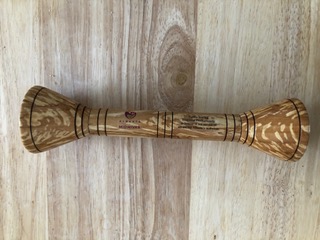
Colleagues described Sandra as a walking encyclopedia on childbirth. She received many awards for her work, including a 1982 Women Celebrate Women Award “for her special contribution to the education of women in the safe alternatives in childbirth. Her sensitivity to women's special emotional and physical needs at childbirth has helped many women achieve a more humane birth experience”. Sandra was also recognized in the Alberta legislature on May 5, 1999. In 2020—International Year of the Nurse and Midwife—the Alberta Association of Midwives (one of the organizations she had served on as President) reaffirmed Sandra’s legacy by making her an honorary member and later presented her husband Ron with an engraved Pinard horn.
The Pinard horn is the world’s oldest instrument for listening to a fetus’s heartbeat (cavewomen just used their ears). Here is a photo of Sandra’s legacy Pinard horn.
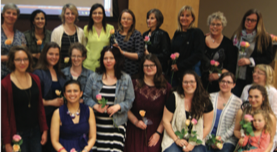
Here’s a picture from that first May 5 International Day of the Midwife celebration at Mount Royal. (2015)
Belle is writing a book about Sandra Botting and Alberta's Midwifery history.