 MENU
MENU



Mount Royal University launches School of Computing Sciences and Mathematics
Major transformations are being made in the mathematical and computing science disciplines in Canada. According to CompTIA industry data, Canada’s net tech employment grew substantially over the last five years and now totals more than 1.5 million workers. Between 2020 and 2025 alone, the sector added more than 300,000 new roles. Artificial intelligence (AI) is being targeted as a major driver of the national economy, with the global AI market projected to reach US$4.8 trillion by 2033. In June, Canada’s federal government announced its “AI for All” strategy, which will provide up to 90,000 AI-related jobs and work placement opportunities for young Canadians and make the nation’s industries more competitive in the global economy.
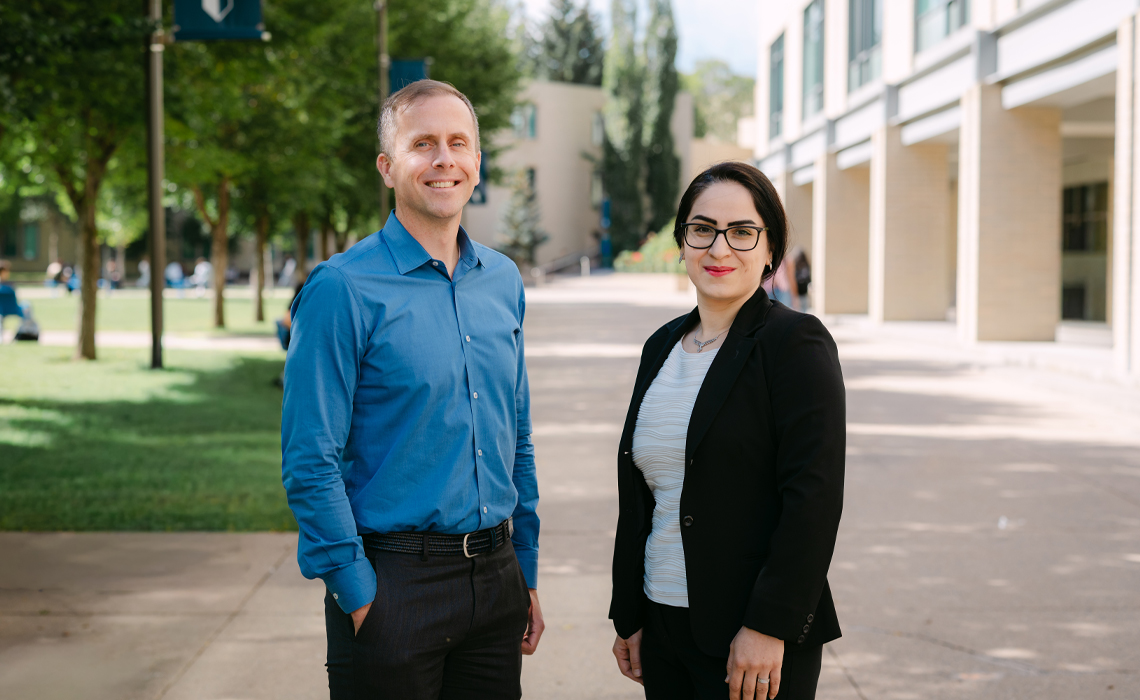
To address these opportunities for students, scholars and the community, Mount Royal University’s Faculty of Science and Technology is launching the School of Computing Sciences and Mathematics. Dr. Yasaman Amannejad, PhD, is the School’s inaugural academic director, with Dr. Brady Killough, PhD, serving as its chair. Amannejad’s focus will be on advancing strategic initiatives, interdisciplinary connections, external partnerships and the School’s broader profile, while Killough will continue to strengthen the School’s programs through academic operations, curriculum, faculty support and governance.
“The establishment of the School of Computing Sciences and Mathematics recognizes the significant expansion of these disciplines at Mount Royal University and their growing influence across society,” Amannejad says. “Our distinctive strength lies in the combined expertise of our faculty in computer science, data science, information systems, mathematics and statistics.”
Killough explains that the School will house three degree programs: computer science, computer information systems and data science. It will also be the home of the Spatial Data Science Certificate (a one-year post-bachelor’s certification). Across these programs, the School has an annual target of approximately 350 new students, leading to a full cohort of more than 1,000 students by 2027.
To support this growth, Mount Royal received two different rounds of targeted enrolment expansion funding from the Government of Alberta, as well as significant support from TECTERRA for the launch of the Spatial Data Science Certificate, Killough says.
“The first round of provincial funding supported increased enrolment in our computer science and computer information systems programs, and the second helped launch our data science program. Together with the investment in Spatial Data Science, these supports provided the capacity to expand our programs and ultimately establish the School.”
In addition to the three degree programs and certificate, the School of Computing Sciences and Mathematics will offer four minors. It will also deliver required courses across a number of MRU programs, including all Bachelor of Science programs, the Bachelor of Nursing and the Bachelor of Midwifery, as well as provide courses that develop mathematical, computational and data literacy skills through general education options for all MRU students.
“The School brings together a large and growing group of programs and disciplines that already have an impact well beyond their own students,” says Dr. Jonathan Withey, DPhil, dean of the Faculty of Science and Technology. “Creating a School gives that work greater coherence and creates a stronger foundation for continued growth, partnership and innovation.”
Creating a stronger, more visible identity while supporting innovation and collaboration
Mount Royal’s School of Computing Sciences and Mathematics will provide a clear point of connection for colleagues across the University and external organizations seeking expertise or collaboration in the School’s disciplines.
“There will be a stronger platform for interdisciplinary research, applied innovation, knowledge mobilization and partnerships that can grow over time,” Amannejad says.

“Mathematical and computing expertise are needed across a growing range of fields. Health care and life sciences rely on health-data analysis, medical imaging and bioinformatics. Energy and environmental sectors use mathematics and computing for resource optimization, climate modelling and power-grid management. Finance, transportation, manufacturing, government and many other sectors need professionals with expertise in data analysis, cybersecurity, information systems, automation, risk modelling and decision support,” she continues.
As AI assumes more routine functions, technology is evolving alongside. Organizations increasingly need professionals who can build reliable systems, apply AI responsibly in real-world settings, assess its results, safeguard data and exercise sound judgment about its use, Amannejad says.
“This work continues to depend on strong foundations in mathematics and computing that students develop through our programs, together with professional expertise needed to apply that knowledge effectively.”
Data from the Canadian Occupational Projection System (COPS) projects that job creation is expected to account for approximately 58 per cent of job openings for software engineers and designers from 2024 to 2033, with employment growth expected to be higher than the national average. Mathematics continues to provide essential foundations for applied fields such as data science, with COPS predicting that job creation will account for approximately 46 per cent of job openings up to 2033.
“For us, preparing students means more than training them to use tools that may quickly become obsolete,” Amannejad says. “We provide durable foundations in mathematics, statistics, programming, algorithms, data and systems, while developing problem-solving, communication and critical-thinking skills.”
Advancing interdisciplinary and experiential education across MRU
Experiential and work-integrated learning are also an essential part of MRU’s student education. Experiential learning is a hands-on approach allowing for deeper understanding of concepts through action and reflection, while work-integrated learning connects students with employer, industry and community partners in order to apply knowledge in a workplace or practice setting, allowing students to contribute meaningfully within their fields.
“Applied projects, research, and work-integrated learning give students experience with current technologies while building their ability to learn and adapt as those technologies change,” Amannejad says. “This combination prepares graduates for today’s opportunities and for roles that will continue to evolve throughout their careers.”
For now, the School will be housed in existing spaces dedicated to mathematics and computing sciences, along with newly renovated spaces in Mount Royal’s G-wing.

“The longer-term vision is for the School to move into the proposed Health Science Innovation Centre (HSIC),” Killough says. MRU is currently working on funding for the HSIC, which will be a state-of-the-art hub where the next generation of health and science professionals will engage with practice-based learning, multidisciplinary research and leading-edge technology.
With the additional capacity to build and sustain connections both within Mount Royal and with industry, government, community organizations, alumni and other academic institutions, the School of Computing Sciences and Mathematics will form collaborations to inform further curriculum improvements and create numerous new opportunities for students.
“These opportunities will help students connect academic knowledge with real-world challenges and understand how different areas of expertise contribute to meaningful solutions,” Amannejad says.