 MENU


Class project churned into successful business
It’s not just rich in flavour, butter is also rich in history. The creamy dairy product that makes all foods taste better spans many centuries, cuisines and cultures. It is said to have been first invented between 6500 and 8000 BCE, and since then has become a staple for eating, cooking and baking, surviving the introduction of margarine and eventually establishing its own online community.
Among the first trends to emerge was #buttertok, where people on Tik Tok became obsessed with the idea of making their own butter. That turned into a niche group becoming obsessed with European butters, specifically those from France. A quick search on social media will reveal dozens of videos of where to go in Paris to get French butter wrapped specifically for packing in a suitcase to bring back to North America.
People are making butter candles to serve with bread, butter boards with different flavours; both salty and sweet, even churning their own butter on runs. Don’t believe it? The CBC penned a story about a local runner/churner in March.
Butter is everywhere. It was deemed 2025’s most unexpected food trend by Forbes and the decadent dairy product’s popularity continues to climb.
Terroir’s story
Locally, Terroir Artisan Butter has been having its own moment. Already available in multiple stores and restaurants, Terroir had an ultra-successful campaign with Made by Marcus in the summer and was recently dubbed one of the best butters in Canada by a TikToker known as Canada’s butter lady — Maudelinee.
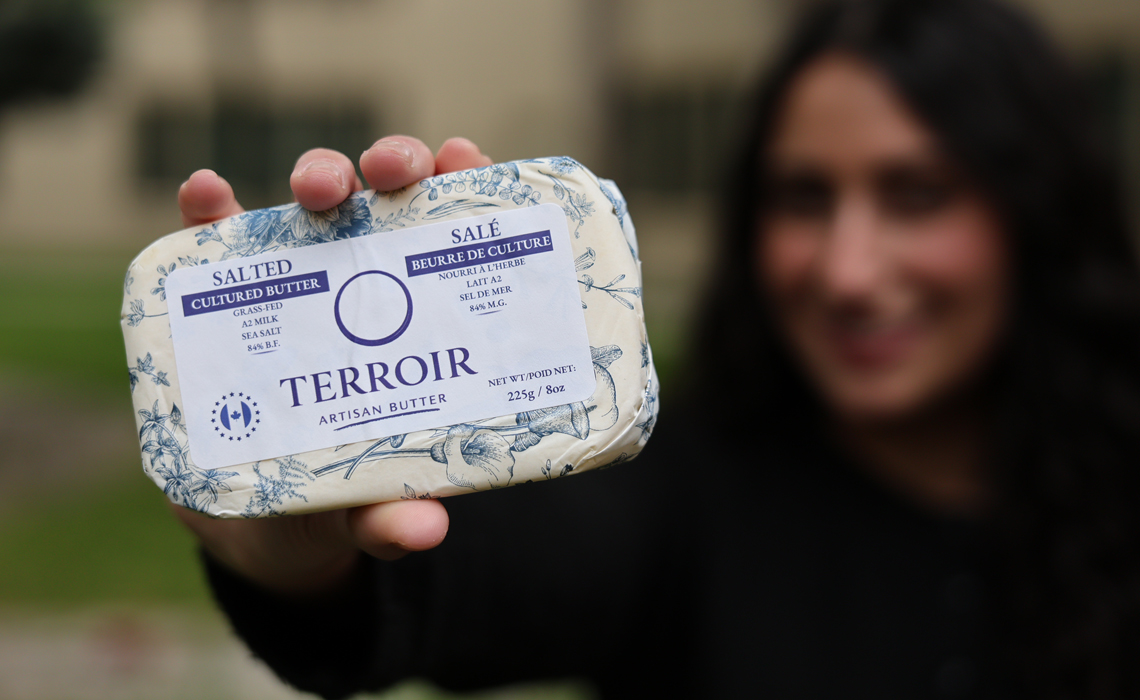
Terroir is a cultured butter made with A2 grass-fed cream and the closest thing you can get to a French butter on this side of the pond that is also produced locally.
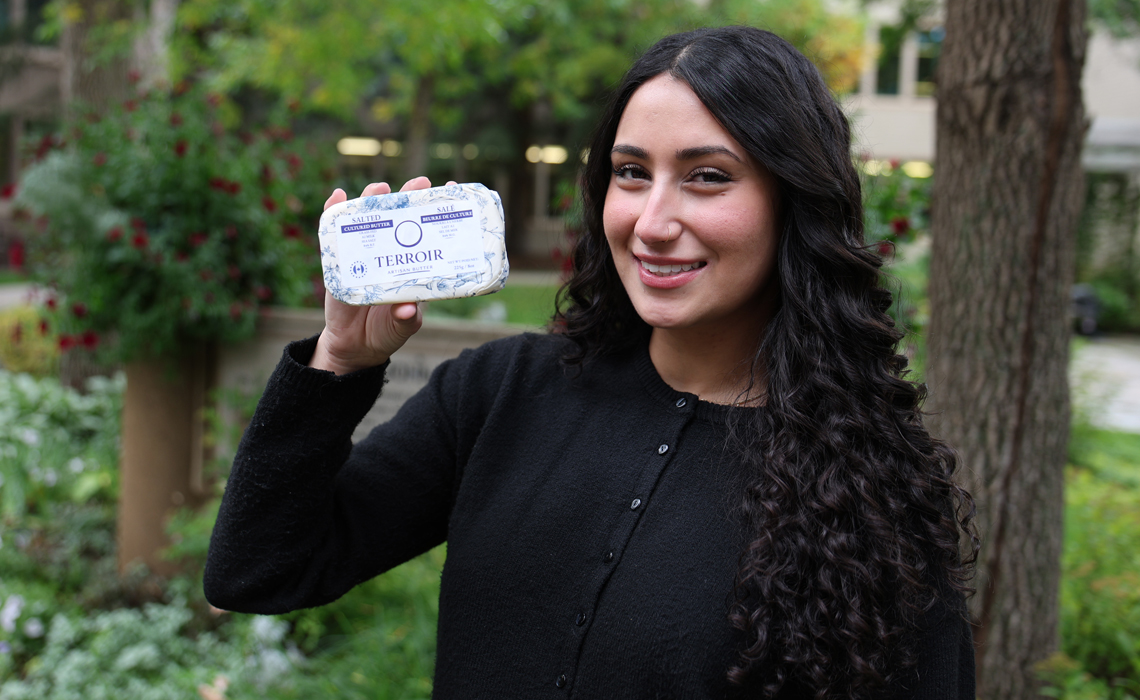
The inspiration behind the company, says co-founder Veda Mottahed, came in part from a class project at Mount Royal University.
The fourth-year Bachelor of Business — Marketing student owns and operates the business with her dad.
The duo loves bread and butter and have had many discussions about why butter in Europe seems to be so much better in taste and spreadability. They were talking about it more seriously, concluding that it was the fact that most French butters are cultured (more on that later).
At the same time as these discussions, Mottahed was in a marketing class where she had to do an assignment about a company she admired. She chose Maison Bordier, which is widely regarded as one of the best butters in the world. Her project had vastly expanded her knowledge about butter and how it is produced as well as what makes cultured butter so much better.
This all led to her and her dad experimenting with making and culturing their own butter in their kitchen. This was at the end of 2025, entering into January of 2026.
They started sharing it with their loved ones.
Their small audience loved Terroir so much they encouraged Mottahed and her dad to bring it to stores, “just for fun,” Mottahed says. The product was a hit there as well, and they realized the demand was there. They needed to immediately start to scale the business.
Selling commercially to stores includes a lot of regulations, Mottahed says, so their home kitchen would no longer cut it.
“We needed a production facility, equipment, and we needed to source cream.”
Pass the milk
Sourcing A2 cream in Alberta is surprisingly challenging.
“You’d think being in Alberta there are so many cows, so it can’t be that hard, but most of them are beef cattle. So to source dairy cows, specifically ones that produce A2 milk, it took months.”
By April, they had secured their facility and a source for A2 cream, and marked their first sale on April 27. By August, Terroir had four employees to keep up with demand. Today, their products can be found in more than 50 stores across western Canada and a few restaurants. That includes the Rimrock Resort Hotel in Banff, where Terroir Artisan Butter is used for their bread service.
“You wouldn’t believe the appetite for butter in this city.”
That appetite goes beyond the city limits, as shipping is available across Alberta as well as throughout Saskatchewan and B.C.
Mottahed and her dad have requests to ship from outside of Canada and other locations within the country. Their next goal is to scale and move distribution out east.
“That is our goal, but logistically it is very hard and distribution is not easy. It’s butter, so it has to stay cold.”
Butter science
All of Terroir’s products are made by hand, which is a labour of love.
“To culture butter, means you are adding good bacteria back into the butter and letting it ferment,” Mottahed explains.
“So when you do that, the bacteria consume the sugars and convert them into many flavour compounds, one of them being diacetyl.”
Diacetyl naturally occurs when you ferment butter. She explains that the same compound has also been used in artificial butter flavourings, helping create that delicious buttery smell. When you smell that familiar movie theatre butter aroma, what you may actually be smelling is artificial diacetyl.
She says it’s hard to describe how cultured butter tastes and smells, “it’s just so buttery, you know what I mean. That classic butter flavour but better, creamier and a little tangier.”
To really taste Terroir or any cultured butter in its best form, it needs to be at room temperature.
Mottahed also recommends having it with the best, freshest bread you have access to.
Another (although maybe unconventional) way to enjoy cultured butter is melted on ice cream. Butter-dipped soft-serve cones were made popular in the summer of 2025 by a New York city chef, and by 2026 the trend had gone viral worldwide, even appearing on the Calgary Stampede Midway.
This led to Mottahed meeting with local ice-cream makers Made by Marcus to discuss a potential collaboration.
“We just thought it would go so well with our butter,” says Mottahed. “Our goals aligned with what we wanted our campaign to be and we just decided to do it.”
The collaboration launched on Aug. 5 and quickly became the must-have treat of the summer. Mottahed says it quickly became the number-one selling cone at the Inglewood Made by Marcus location for the three weeks it was offered.
Since it can only be read about now (although keeping fingers crossed for another rollout next summer), we asked Mottahed to describe a butter dipped soft-serve cone.
She says the flavour profiles are very similar.
“First off, it is decadent. It is a heavier treat so maybe leave some room or plan to share. But to describe it; it's a salty, sweet extra-creamy ice cream.”
Inspiring fellow students
Mottahed hopes that fellow students who have an idea for a business feel inspired by her story to just do it.
“You don’t have to know much to start. If you have an idea you can do the research and learn as you go. You don’t have to be a professional in it or an expert at the start,” she says.
She went from knowing about how much she enjoys butter to running a successful artisan butter business in a matter of months.
“I would say I am very knowledgeable in the butter department now but I wasn’t six months ago.”
She also says she is still learning how to balance running a business while being a student. While she is thankful that her dad is able to step in a lot of the time when she is in class, there are times where she does have to focus on the business too.
However, going from class right into business meetings has its benefits, says Mottahed.
“Going to work I can see how much I am applying from the classroom when I am working. I am learning every single day and I think I will continue to for as long as I live.”
Mottahed draws on her classroom lessons around designing and managing an impactful brand. She also applies many of her relationship building skills when working with new vendors. Her courses in management and organizational structure are especially valuable now that she is managing four employees.
“Our program is about more than teaching marketing concepts; it is about developing capable, creative, and confident graduates who can think strategically, adapt to changing business environments, and make a difference in the organizations they join,” says Donna Dumont, MBA, Acting Chair and Associate Professor in the Department of Innovation and Marketing.
She says seeing students like Mottahed achieving success in their chosen field is one of the most rewarding parts of the job for faculty.
“Watching students gain confidence, recognize their potential, and begin making meaningful contributions to organizations even before graduation is incredibly rewarding. It reinforces the value of what we do as educators,” she says.
Mottahed is one of many Mount Royal student and alumni entrepreneurs. Like her many come from the Bissett School of Business.
Dumont says in addition to class size, one of the strengths of the Marketing program specifically is the innovative, work-integrated learning experiences students take part in.
“Our capstone courses are an excellent example, as students work directly with real clients, addressing actual business challenges and providing organizations with meaningful marketing insights, strategies, and resources.
Dumont says these experiences allow students to move beyond theoretical knowledge and develop the practical skills, confidence, and problem-solving abilities employers value.
“By the time they graduate, our students have already had opportunities to apply what they have learned in professional settings. They are well prepared to hit the ground running and make an immediate contribution in the workplace.”