
Bridging two worlds

An educational journey of self-discovery
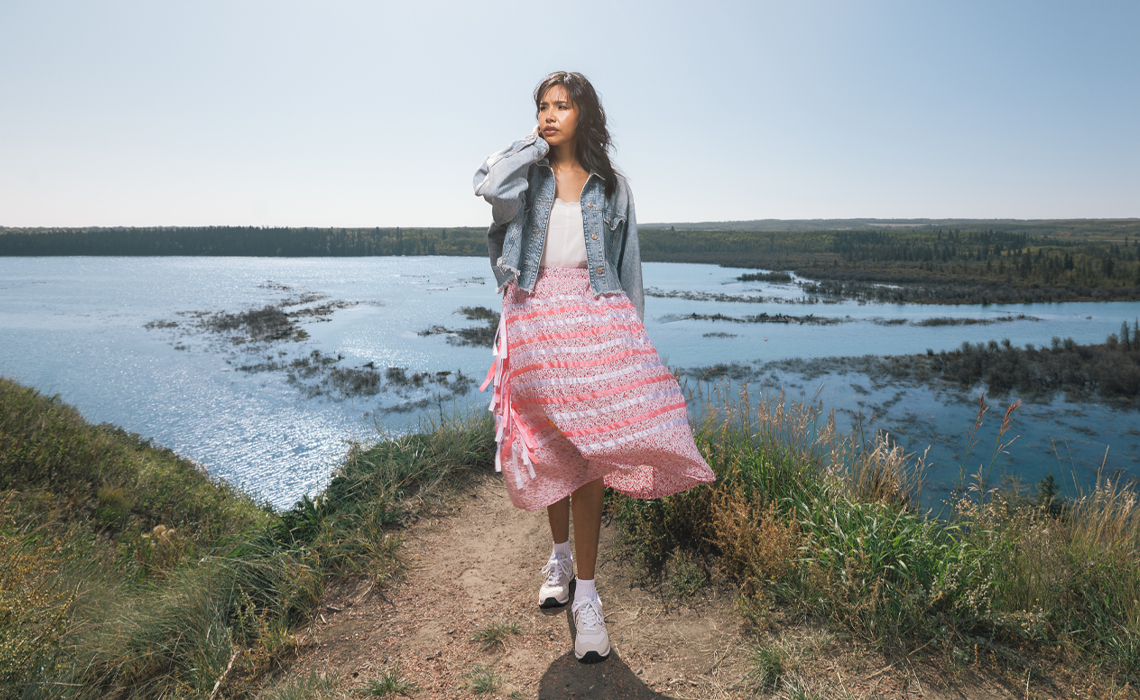
Sofia Baptiste stands on a path near a lake, framed by nature.
Sofia Baptiste reflects on her time at Mount Royal University, her journey as a scholar and artist, and how reconnecting with her Blackfoot identity shapes her academic work.
share

When Mount Royal University alumna Sofia Baptiste first arrived on campus, she was searching for a post-secondary education but felt that she was living in two worlds, unsure about how her Blackfoot, Tsuut’ina and Cree heritage fit in with academia. What she found was not only academic growth, but also a deeper connection to her own identity through Powwow dancing and Indigenous ways of knowing. Her time at MRU became a journey of self-discovery, grounding her more fully in her Blackfoot, Tsuut’ina and Cree heritage.

Today, Baptiste is completing her Master of Education in the Niitsitapiisinni: Real Peoples' Way of Life Program at the University of Calgary — a program that emphasizes Blackfoot knowledge and worldviews while preparing students to work in education, health care and community leadership. Building on her undergraduate degree in anthropology, with double minors in sociology and Indigenous studies, she continues to explore how academic and cultural teachings can be braided together to shape meaningful, community-centred work.

Beyond her studies, Baptiste is also a model, actor and traditional Powwow dancer, roles that allow her to share her culture and creativity with wider audiences.

We were recently able to catch up with Baptiste for an update on her journey. She reflected on her time at MRU, her continuing journey as both a scholar and artist and how reconnecting with her Blackfoot identity has shaped the way she moves through the academic world.

What led you to apply to the anthropology major at Mount Royal?

I was taking university classes and was upgrading through the Iniskim Centre, and was really drawn to the professors in the anthropology courses that I took. I liked their personalities and how they taught their class, and I loved the content.

I do my best to balance my head and my heart, and I follow a lot of what feels right with my intuition, so the anthropology program felt like I was moving in the right direction.

Looking back on your undergraduate journey, is there something you’re especially proud of?

There's a lot that I'm very proud of in my undergrad journey at MRU. There were a lot of barriers that I had to navigate. I had many beliefs I grew up with about how society is structured, influenced by my experiences as Blackfoot, Tsuut’ina and Cree. When I came to MRU, I had to learn a lot of things. Not only did I have to learn how to study, I had to learn how to live in the city and unlearn some of my beliefs about myself.

There were a lot of things I had to figure out as I moved through school. If I came up to a barrier, I would have to find resources or help to get through. One of the best things I did was unlearn my negative self-view that I wasn't smart. Once I learned how to study, I was able to get really good grades through hard work, and it helped me recognize that I'm actually smart. It took a lot of time and a lot of effort, but I am so proud of myself for getting to that new belief.

Were there any people or experiences at MRU that had a lasting impact on you?

A huge part of my undergrad was connecting to my culture. I was able to meet with other people from other communities and that led me to so many opportunities to learn more about my culture.

Because of those connections, I started my modelling career when MRU hosted Otahpiaaki Fashion Week. That was the first time I walked a runway. Since that experience, I've been able to travel with modelling, doing runways and photography, including Western Canada Fashion Week, the Santa Fe Indian Market (SWAIA), a short film called Blackfoot Skies Makoiyohsokoyi for the TELUS Spark Science Centre, and a campaign for the Calgary Airport. One of the coolest experiences that has come from modelling was meeting muralist and painter La Morena and being the subject of one of her murals in Great Falls, Montana. All these opportunities started at MRU because I walked in that first fashion show!

Another experience that has helped me connect to my culture started at MRU when I learned how to Powwow dance through the Powwow fit class that was offered through Iniskim.

I've danced with Reuben and the Dark a few times, including at The Bella. I first performed with them in 2022, and I've been performing with them every year when they're in Calgary or the area. They've been really inviting and warm, and it's always been a good experience.

When my friend Nevada and I dance on stage with them, we try our best to feel the songs and try to hear what kind of style of dance it is. We both dance Jingle, but sometimes we dance Fancy, so it's been a really cool experience with them!

Did you have any experiences at MRU that helped you grow outside of the classroom, in terms of leadership, confidence or life skills?

One of the things that I really enjoy doing is helping out with community events. And I got the confidence to do this because when I was at MRU, I volunteered a lot for Cory Cardinal at SAMRU (the Students’ Association of Mount Royal University). I remember when I started working and volunteering with him, it was out of my comfort zone, and he helped me to push past that discomfort, and that has helped me in my life so many times.

On the academia side of growth, my Indigenous studies professor Gabrielle Lindstrom (Weasel Head) has had a very important, lasting impact on me. She taught me a lot and gave me knowledge that is transferable to work, but also helped me build my confidence and belief in myself that I can do anything.

What impact has pursuing higher education had on you and your worldview?

I think what’s well known by Indigenous students or people who work with Indigenous methodologies or even in communities who have a culture that's different from a dominant culture, is that pursuing higher education can feel like walking in two worlds. When it came to my undergrad, that analogy really helped me with learning. I took Indigenous studies courses in anthropology and sociology, which really helped ground me and keep my foundation as both a student and an Indigenous person.

When I started my master's, which is Blackfoot-focused, it helped me understand who I am as a Blackfoot person and then also how to navigate that within these two worlds of academia and my culture.

I wanted healing for myself, for my family, for my community. I know a lot of Indigenous students aren't just thinking about ourselves when we go to school. We're thinking about our families and communities, and for me, when I came to school I was going through a really challenging time. I wanted to figure out my place, to figure out how I can contribute to my communities or to the community here in Calgary, and I'm still trying to figure that out. I am continuously trying to find that balance of honouring who I am as an Indigenous person while being in academia.

It has really helped me to appreciate my family, all my loved ones who support me and helped me finish my degree and supported me in many different ways. I'm also so thankful to past scholars, who have built frameworks for Indigenous students today.

These last few years as a student have been so profoundly beautiful and healing. Pursuing higher education has had such a meaningful and positive impact, despite it being really challenging at times.

 
How did your time at MRU help you build the confidence and belief in yourself to take the next step into a master’s program?

It was working with Gabrielle Weasel Head!

When I first saw her, she walked into the classroom and I had no idea that my professor would be Blackfoot. I remember being in awe. It was the first time I'd had a professor who was Indigenous in my life. Before that, I didn't have a lot of clarity on what I was going to do in life; I just knew that I needed to get my degree. But when I saw her, it really encouraged me to go further with my education.

I grew up on the reserve in Pigeon Lake, and I went to school up north, and one of the things I just didn't realize was the steps it took to get to certain things in research. So that was one of the things I learned here that really changed my view of how things work.

I was able to work as a research assistant for Gabrielle, with our research focus being Transformative Learning and Blackfoot Resilience, and being able to have a good student-professor connection helped me feel confident when I applied to my master's degree.

I really did my best when I was at MRU to utilize all the resources that were offered. Honestly, all the experiences and opportunities that I had at MRU, and the connections, and my whole experience helped me succeed.

How do you stay connected to your Indigenous identity while studying, and were there any particular challenges or supports that have stood out to you?

Before I came to MRU, I was told that it has a really strong Indigenous community, especially through the Iniskim Centre. Having that support was really important, and once I was settled in, it became a comfortable place where I could go and hang out or study and make really good connections with the staff and other students.

I feel so grateful for all those experiences that I had, because now I feel that I know who I am as a Blackfoot person, and my importance and worth as a human being and as a woman, and I know my gifts. Now that I have those connections, I know that I have always had it in me. I was trying to fit into a way that I wasn't. Now I know who I am, and I can find a way towards healing. I'm really thankful and really honoured, and I'm just so proud of knowing who I am.

So for students who are just coming into these places of academia, or specifically MRU, I always tell them just go and make those connections, and I always tell them about the Iniskim Centre.

How did your time at MRU shape the way you see yourself today?

It helped me build confidence and belief in myself because of the way courses are structured and the way professors interact with students. The support from them as experts and professionals really does prepare you for your career or the next step in your education.

I can do challenging things and figure it out on my own, but if I did need help, I would just ask them or I would seek help through a resource on campus. A lot of the practical and professional parts of life, that's what I would say Mount Royal helped me with, and to this day, I still use a lot of that knowledge.

If you could give advice to other students considering post-secondary education, or to those hoping to go from undergrad to a master’s program, what would you say?

Make sure you’re ready because it's a commitment, and everyone has their own journey.

I also want to tell students to access the resources that are offered! MRU is really set up to help you succeed as a student. I took all the courses in the Riddell Library and Learning Centre through Student Learning Services, and that's what helped me a lot.

I also want students to know when they are choosing their program that although it's important to pick something that you're passionate about, do your research and make sure it also aligns with where you want to go in life. A big thing for me was having a goal. That's what helped me get through the really hard parts during my undergrad. I could remind myself when things got really hard that I have a purpose, and there's a reason I'm doing this, so I've got to finish.

And for those students who know they want to go into a master's program, research the program early and learn what is required to apply so you can take those steps to get in while you’re doing your undergrad.

What kind of impact do you hope to make in the world through your work, and what drives you to that goal?

The big thing for me, and something I'm still trying to navigate, is decolonization and how that fits into education. So I wanted to put my focus on Indigenous culture and language, and being a part of that work.

Everything is connected and relational, and that's a big aspect of Indigenous research, but it's also how it is in our communities. So for me, I want to use my education to contribute to my community and the world, especially through healing.

My undergrad helped to build my education foundation of understanding settler colonialism and decolonialism. Now that I’m in my Master's program, I am focused on the language and the outcomes that can be healing for people, because that was the outcome for myself. I'm still in that phase of learning both with post-secondary education and myself. The big thing for me is healing.

Learn more about the Bachelor of Arts — Anthropology at MRU.
Explore the program